


TL;DR: Open-source inference can change a project's cost mix, but it won't reliably shrink an ₹8-lakh quote. Compare managed, self-hosted, and hybrid options under identical scope, quality, workload, and time assumptions before approving a price.
Key Takeaways: - A model license is one cost line. Data, integration, evaluation, deployment, and ownership often dominate the proposal. - Self-hosting trades vendor fees for compute, on-call work, upgrades, and operational risk. - The CEO should approve only a scope-locked architecture supported by measured evidence and explicit commercial boundaries.
The ₹8-Lakh Quote Is Not a Model Bill
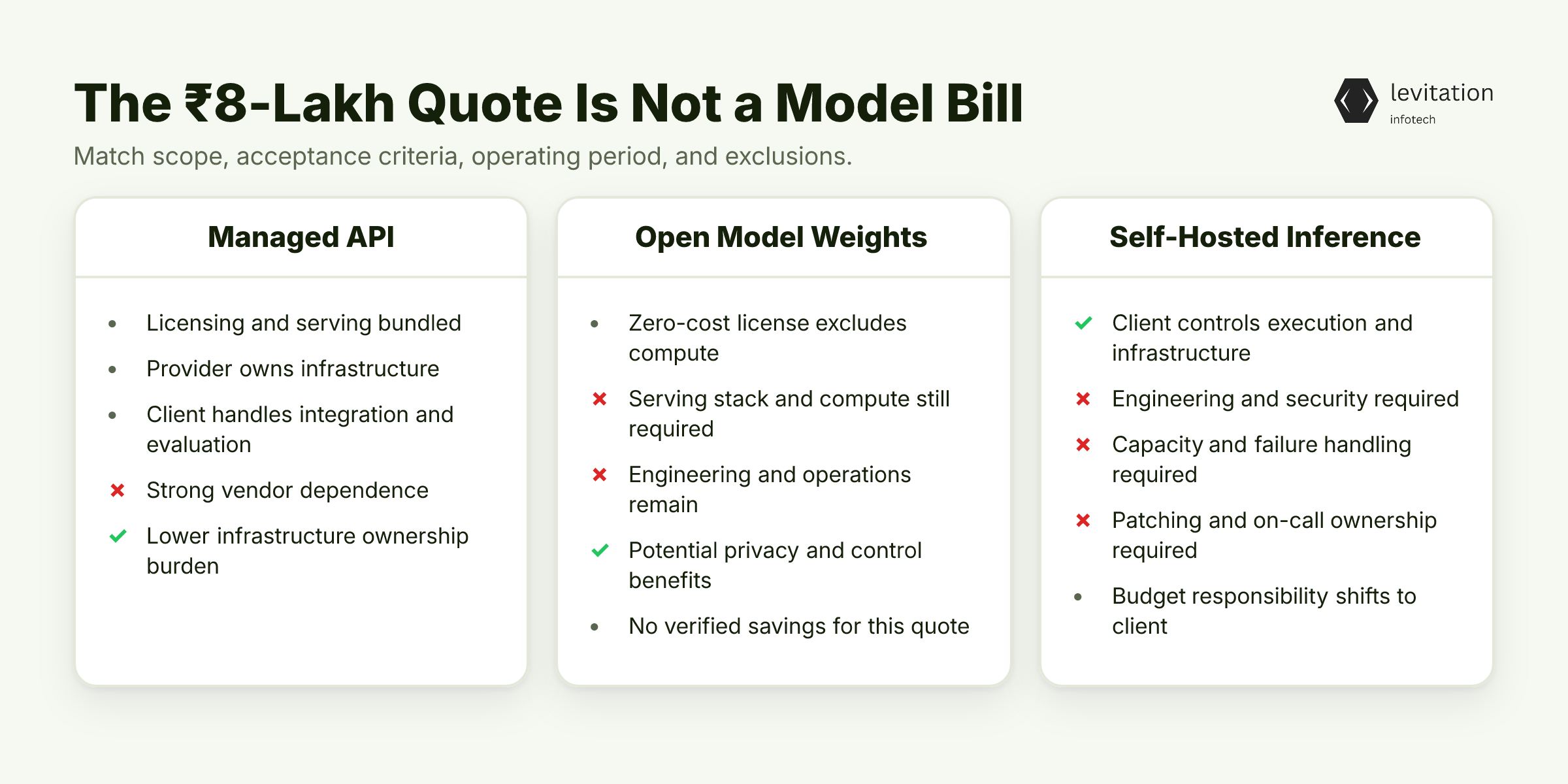
A zero-cost model license does not make an ₹8-lakh AI project free. Treating it that way hides a larger operating bill behind the visible quote.
The CEO hears that open-source inference will cut the proposal. No revised scope, acceptance criteria, or comparable cost baseline comes with that promise. That absence is the warning.
The verified source set provides no definitive figure or direct comparison between open-source inference and an ₹8-lakh Noida development quote.
Even a broader AI development cost guide is not a like-for-like baseline unless its scope and commercial assumptions match. The comparison must isolate scope, operating assumptions, and commercial boundaries. It cannot infer savings from model selection.
The Cost Category Trap
Compare three layers before accepting any savings claim. In the managed API layer, licensing and serving are bundled, infrastructure belongs to the provider, and client engineering covers integration and evaluation. Vendor-led operations also create strong vendor dependence. In the open model weights layer, weight access does not include infrastructure. The license, serving stack, compute, engineering, operations, and accountable owner still matter. In the self-hosted inference layer, the client controls execution and infrastructure but also assumes engineering, security, capacity, failure handling, patching, and on-call ownership.
1comparison_envelope:2 scope: identical3 acceptance_criteria: identical4 operating_period: identical5 exclusions: itemized
Research identifies savings, privacy, control, and reduced lock-in as benefits. It does not establish a reduction for this quote.
Any revised AI development services proposal must use the same envelope. That includes acceptance criteria, operating period, and excluded costs.
The useful question is not whether the model license is free. It is which costs move when the model changes, and where the budget lands next.
Where the Budget Goes After Model Choice
Model choice changes which costs move. It does not remove data preparation, process redesign, or user adoption.
One-Time Engineering Cost
Separate the initial build into five clear buckets. Discovery covers workflows, users, constraints, and success criteria. The application bucket covers orchestration, interfaces, error states, and feature work. Data covers cleansing, labeling, permissions, retrieval sets, or training sets. Evaluation covers test sets, quality gates, failure analysis, and regression tests. Integration and launch covers APIs, security, observability, deployment, and handover.
Data preparation and infrastructure are common AI development cost drivers. Those costs remain even when model weights cost nothing. The build ledger ends there, but ownership does not.
Recurring System Ownership
After launch, extend the ledger to recurring operating costs: hosting, inference, and reserved capacity; monitoring, incident response, and support; model, dependency, and hardware upgrades; retraining, evaluation refreshes, and access reviews; and internal training, process changes, and support handoffs.
Change-management work often extends beyond the build budget. It should appear as its own ledger category.
1quote_classification: - one_time - recurring - usage_dependent - optional
Use these fields for every quote line:
- Quote Line: Discovery and architecture | Current Assumption: Vendor-led | Open-Source Change: No base-scope change | New Owner: Product lead plus architect | Cost That Remains: Workshops and sign-off
- Quote Line: Data and application | Current Assumption: One build budget | Open-Source Change: Serving work separates in the self-hosted case | New Owner: Data and product teams | Cost That Remains: Preparation and workflow work
- Quote Line: Model evaluation | Current Assumption: Bundled acceptance testing | Open-Source Change: Test matrix expands | New Owner: ML and QA teams | Cost That Remains: Quality gates
- Quote Line: Infrastructure and support | Current Assumption: Provider-managed | Open-Source Change: Client-managed when self-hosted | New Owner: Platform and on-call teams | Cost That Remains: Security, updates, and incidents
This structure exposes the hidden AI development costs that enterprise AI solutions proposals often combine.
For an India-focused inference comparison, keep development spend separate from operating spend. Ask the vendor to classify every line before discussing a discount.
The visible shift is the trade-off: vendor fees fall while client operating ownership rises. Which side grows faster under the actual workload?
How Open-Source AI Inference Changes the Cost Shape
Open weights change access, not accountability. Production inference still needs serving software, compute, evaluation, observability, security, upgrades, and named owners.
AirLLM's published demonstration runs a 70B LLM on a 4GB GPU. That illustrates a memory-feasibility approach. It does not show that every production workload becomes faster or cheaper.
Savings depend on four operating choices. Workload-tailored serving improves hardware utilization when traffic matches the setup, while controlled infrastructure removes some managed-service fees. Sensitive data stays inside a chosen operational boundary when deployment is designed for it, and open weights reduce model-level switching friction when the team can host the model.
The offsets are equally concrete. Low utilization turns reserved compute into idle cost, and extra engineering can erase the licensing saving when it exceeds the fee avoided. Failure handling and on-call work need named owners, while patching and upgrades create a permanent engineering stream.
Capture utilization during the same workload rather than trusting a demo:
1nvidia-smi dmon -s pucm -d 1
Attention behavior, KV-cache behavior, memory use, batching, quantization, and latency determine the operating envelope.
Our guide to AI/ML training explains those inputs. How LLMs fetch and respond also shows why request shape matters.
Open-source inference changes the composition of AI development cost. It does not remove the need for generative AI development, evaluation, or production ownership.
Use these as starting scores, not findings:
- Option: Managed API | Upfront Engineering: Low | Recurring Cost: Usage-linked | Operational Burden: Low | Control: Medium | Portability: Low | Time to Production: Short
- Option: Self-hosted open model | Upfront Engineering: High | Recurring Cost: Compute-linked | Operational Burden: High | Control: High | Portability: High | Time to Production: Longer
- Option: Hybrid architecture | Upfront Engineering: Medium | Recurring Cost: Blended | Operational Burden: Medium-high | Control: High | Portability: High | Time to Production: Complex
The shift matters only when costs are compared over the same workload and time horizon. Most open-source-versus-API arguments fail there. A fixed ledger must expose the difference before anyone negotiates the final number. Until it does, lower license fees can masquerade as lower total cost.
Build an AI Development Cost Ledger Before Comparing Options
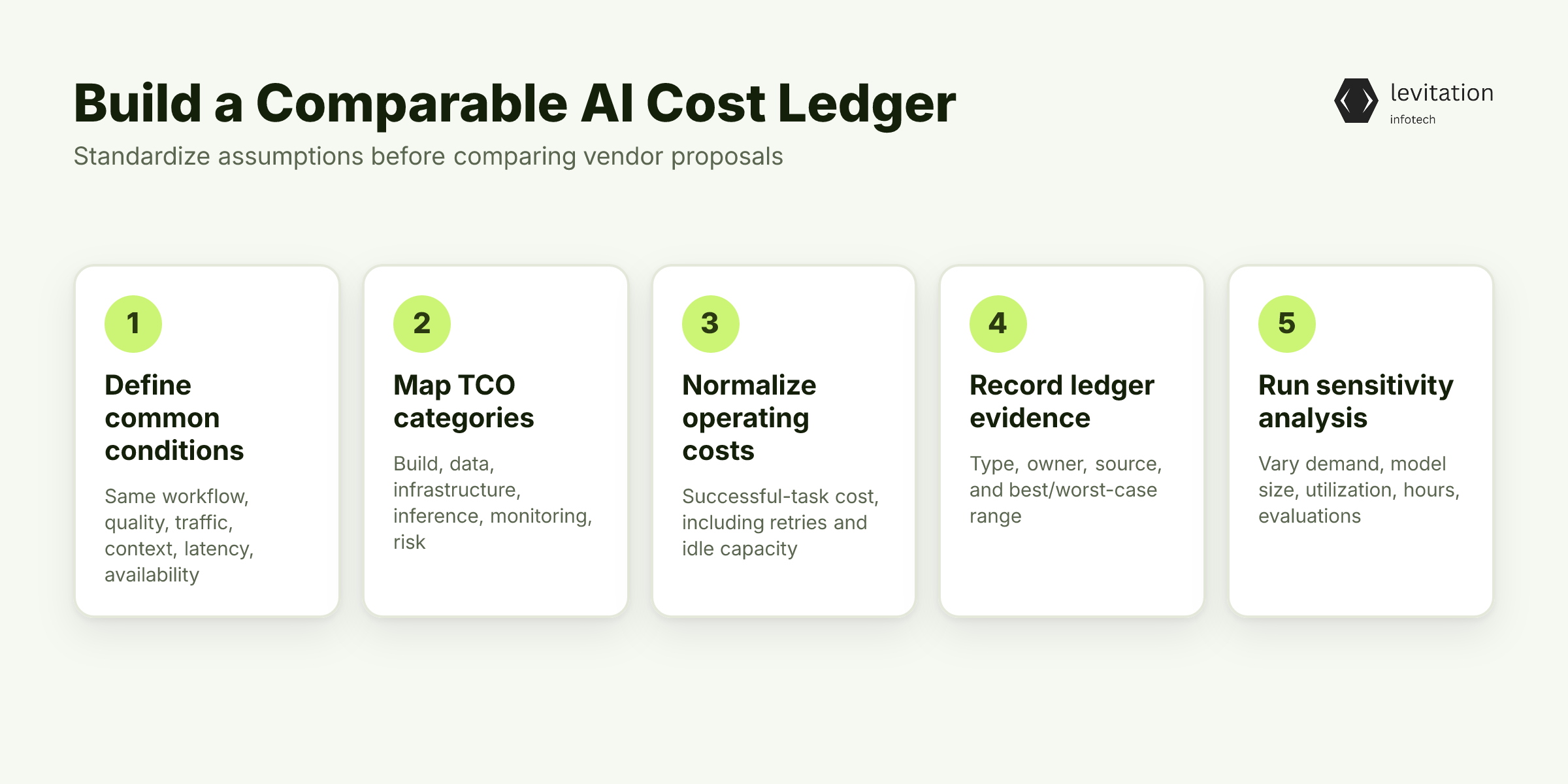
Cost comparisons fail at their boundaries. The CEO needs one formula that both vendors can populate.
Three-year TCO is the sum of build, data, integration, evaluation, infrastructure, inference, monitoring, upgrades, retraining, change management, and a defined risk allowance.
1tco:2 horizon_years: 33 scenarios: - managed_api - self_hosted_open_model - hybrid4 categories: - build - data - integration - evaluation - infrastructure - inference - monitoring - upgrades - retraining - change_management - risk_allowance
Hold every scenario to the same conditions, including the workflow and user journey, the quality threshold and failure policy, the traffic profile, context length, and latency target, and the availability target, support window, and security boundary.
Normalize variable spending by cost per successful task or request. Include retries, failed evaluations, idle capacity, and engineer hours spent operating the system.
Give the ledger these fields. Cost Category names the build, data, inference, or another line. One-Time identifies fixed engineering and preparation costs. Recurring costs continue throughout the operating period, while Usage-Dependent expenses rise with the workload. Owner identifies the accountable vendor or client team. Measurement Source can be an invoice, benchmark, telemetry, or time sheet. Best-Case or Worst-Case Range records the assumption behind each value.
Sensitivity should vary request volume, context length, latency target, model size, hardware utilization, engineering hours, and evaluation frequency.
Standalone AI features, chatbots, and production generative AI applications are not interchangeable cost categories. A defensible engineering estimate must state whether it includes the application, data work, integration, evaluation, and deployment.
If cloud infrastructure, data preparation, monitoring, and compliance are excluded from an engineering estimate, that exclusion must be explicit. This explains why an India AI quote may not match project cost.
When comparing top generative AI companies in India, place each vendor proposal and each open-source scenario into the same ledger. Mark every cell as quoted, estimated, or unknown.
The final artifact should be a one-page memo covering architecture, evidence gaps, commercial conditions, and removable scope.
With a comparable ledger in place, a short evidence sprint replaces assumptions with measurements. It must test the operating claim before either side negotiates the final number. The critical unknown is whether the real workload behaves as the vendor assumes.
Run a Two-Week Evidence Sprint Before Renegotiating
The sprint must test the operating claim, not the architecture diagram.
During Days 1-2, freeze the workload and define a representative task set. Record API cost, latency, quality, manual-review rate, and data restrictions. On Days 3-5, run a controlled bake-off across shortlisted managed and open-source candidates, using the AI/ML training guidance to define quality and evaluation criteria before testing. During Days 6-8, test load, latency, failure, and concurrency while recording cost per successful task, p95 latency, error rate, GPU utilization, recovery behavior, and engineering hours. On Days 9-10, evaluate model updates, dependency patching, access controls, observability, and rollback, with operational ownership measured directly. On Days 11-12, populate the three scenario ledgers and run best-case, expected-case, and worst-case sensitivity checks. Finally, on Days 13-14, write the revised statement of work to include scope, exclusions, acceptance tests, operating assumptions, and a quote comparable with the original ₹8-lakh proposal.
AirLLM provides a reproducible setup path:
1git clone https://github.com/lyogavin/airllm.git2cd airllm
Follow the project's README for installation and configuration. Setup feasibility is not a TCO result. Treat AI development services evidence as a workload test, not a demo.
Fix the criteria before testing begins. Why LLM evals approve models that fail explains how weak tests can hide ownership costs.
Reject a scenario when it misses the quality or latency threshold, needs uneconomical idle infrastructure, or creates operational ownership the client cannot support.
The sprint distinguishes among three commercial structures. Each one requires a different contract, not the same discount applied to a smaller quote. The decisive question is which operating costs the client can absorb without creating a second production burden.
Turn the Revised Quote Into a Scope-Locked Investment
Evidence turns an architecture into a commercial choice. Three outcomes are legitimate. The quote falls when the delivered scope falls. The quote stays similar while operating cost improves. A hybrid design reduces both build and inference exposure.
Do not accept a smaller quote that quietly transfers hosting, evaluation, patching, or change-management duties to the client. The contract must name every owner.
1commercial_terms:2 scope: locked3 acceptance_criteria: measurable4 operating_assumptions: explicit5 exit_assistance: required
Require specific clauses to govern the engagement. These include a defined scope, measurable acceptance criteria, and model assumptions. The contract must also detail infrastructure assumptions, usage bands, and support boundaries. Finally, the agreement must address data ownership, upgrade responsibility, exit assistance, and price-review triggers.
The CEO scorecard has four lines: - Business Outcome: What workflow improves? - Time to Value: When will it operate safely? - Three-Year Total Cost: Which ledger supports it? - Reversibility: Can the model, vendor, or volume change?
Execution quality should be assessed through documented delivery evidence, architecture ownership, support commitments, and references rather than license economics. Any vendor-reported timeline, retention rate, or production longevity claim needs a defined scope and evidence. It cannot support the decision without both.
Commercial dependence hidden in AI vendor contracts deserves the same scrutiny.
Before the CEO approves the revised proposal, every procurement question must have a measurable answer. One missing answer can still change the three-year total.
CEO FAQ: Open-Source Inference and AI Development Cost
Before requesting a revised proposal, compare managed APIs, open models, and hybrid options through the ledger and sprint. This process helps CEOs assess top generative AI companies in India without comparing unrelated scopes.
1decision_record:2 horizon_years: 33 evidence_sprint_days: 144 comparison_metric: cost_per_successful_task5 required_boundary: identical_scope
The costliest mistake is leaving the workload, quality threshold, and operating owner undefined.
Will open-source inference reduce my AI development quote?
The quote shrinks if the proposed scope is explicitly reduced. It also shrinks when lower total operating costs exceed added engineering, infrastructure, evaluation, and support. A free model license alone does not qualify.
How much does AI development cost in India?
There is no reliable universal rupee figure because scope, data readiness, integrations, and production requirements vary widely. A defensible quote must state its inclusions and exclusions. It should separate build costs from infrastructure, monitoring, support, and change management.
Is open-source AI inference cheaper than using a managed AI API?
The answer depends on workload volume, model size, hardware utilization, latency, quality, and the team's operating capacity. Compare three-year cost per successful task. Include retries, idle capacity, and engineer hours rather than comparing license fees alone.
How can a CEO reduce AI development cost without reducing quality?
Reduce scope explicitly, stage the release, and reuse proven components. Compare managed, self-hosted, and hybrid architectures against identical acceptance criteria. The strongest savings come from removing unnecessary work.
The first answer is whether the quote can move at all once every cost has an owner. At Levitation, combine our enterprise AI solutions review with a line-item quote audit through our AI development services, rather than relying on a model-free claim.
About the author
Mayank Singh is a software developer at Levitation Infotech, where he builds web and AI-powered applications across the company’s fintech, healthcare, and enterprise projects.