


TL;DR: OpenAI's PostgreSQL success with 800 million users doesn't mean databases are the AI cost problem. It means the database layer is solved while five hidden cost layers orbit it, growing unseen. The fix is not a bigger database. It is an attribution layer that makes every dollar visible to finance.
Key Takeaways: - A single PostgreSQL primary with read replicas can serve 800M users. The real cost problem is what orbits the database, not the database itself. - GPU compute, vector retrieval, cross-region egress, storage growth, and agentic amplification silently dominate the LLM bill. - "Just use open-source" trades license fees for control overhead, talent scarcity, and operational risk. - Cost discipline comes from architecture and attribution, not from the database license you pick. - Building the attribution layer in months rather than years is what changes the CFO conversation.
OpenAI Scaled to 800M Users on One PostgreSQL Primary. That's Not the Headline.
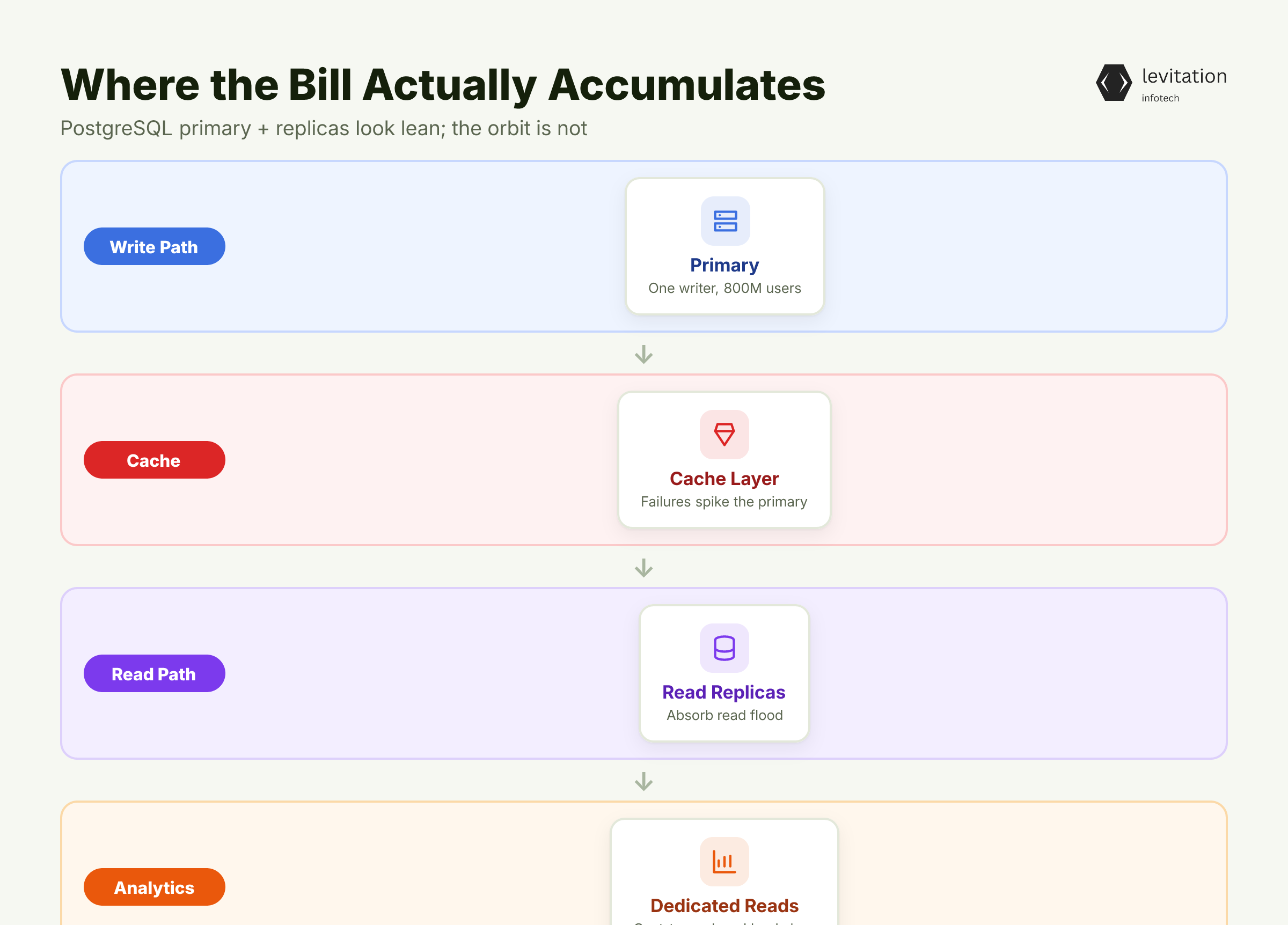
OpenAI just proved you can run 800 million users on a single PostgreSQL primary backed by read replicas. The database is not the problem. Everything orbiting it is, and your CFO has not seen the actual bill yet.
The architecture sounds almost heretical. One primary writer handling every write. Multiple read replicas absorbing the read flood.
No sharding, no exotic clustering, no migration to a custom distributed store. Just a battle-tested relational database doing what relational databases were always meant to do.
But the familiar failure patterns still showed up. Cache layer failures triggered sudden read spikes against the primary. Expensive queries consumed CPU and starved smaller workloads.
New features launched into production and created write storms nobody had modeled. These are not PostgreSQL problems. They are scale problems wearing a database costume.
The single-primary design is not a flex. It is a discipline choice. By keeping the write path consolidated, OpenAI isolates expensive read traffic and pushes it to replicas.
Analytics workloads get offloaded to dedicated read paths. The result is that cost gets tagged to a traffic class, not smeared across a cluster.
Your enterprise AI platform can borrow this pattern. The question is whether you have built the visibility to know which traffic class is draining the budget.
Most teams have not. That gap is where the bill quietly compounds. For a closer look at where finance typically misses the real GPU spend, see the CFO's blind spot on GPU autoscaling costs.
But the PostgreSQL win is exactly what is blinding your CFO to where the real AI infrastructure cost is actually accumulating.
The Five Cost Layers Your LLM Pricing Page Doesn't Show You
Token pricing is the line item every architecture review quotes. It is also the most misleading number in your AI stack.
The LLM pricing page shows you what one model call costs. It does not show you the four other layers that compound around it.
GPU compute burns whether or not a token is generated, because the model has to be warm, scheduled, and resident. Vector database retrieval fees scale with embedding size, index churn, and query fan-out.
Storage grows non-linearly with conversation history, fine-tuning data, and audit logs. Cross-region egress is the silent killer when replicas, LLM endpoints, and users sit in different geographies.
Agentic amplification is the multiplier most teams do not know to look for. Here is the mechanism: an autonomous agent answering a customer question triggers multiple model calls, several retrieval queries, and various tool invocations. All this happens before the user sees a single response.
The user sees one answer. The bill shows a cascade of compound cost components behind that single interaction. Cost attribution has to live at the workflow level. User-level data is too coarse for finance to see the real shape of the spend.
We explored this in why fintech AI costs vary three-fold. The variance is rarely the model. It is what sits around the model.
AI infrastructure cost allocation is the discipline of tagging that spend to the team, product, or workflow that generated it. Most engineering orgs have zero visibility into it.
Their FinOps dashboards show cloud costs. They do not show which workflow cost them a GPU hour. They do not show which agent loop doubled their retrieval bill.
Here is why the well-meaning "just use open-source" advice makes CFOs more anxious, not less.
Why "Just Use Open-Source" Is the Trap That Makes CFOs Nervous
Open-source databases like PostgreSQL eliminate license fees. That is the pitch. It is also the entire pitch, and it stops exactly where the actual cost begins.
The moment you go open-source, you absorb the control overhead. Schema migrations, replication tuning, vacuum strategies, connection poolers, observability hooks. None of this comes free.
It comes with a headcount line item most CFOs forget to model. Then comes talent scarcity. The engineers who can run PostgreSQL at 800M-user scale do not grow on trees.
They are the same engineers every other CTO is trying to hire. They cost like it. Proprietary platforms trade this for a managed scalability curve that compounds as workloads grow.
The trade-off your CFO actually needs to evaluate is not open-source versus proprietary. It is cost versus control versus talent versus scalability.
Four variables. The license model is one of them, and it is the smallest one.
OpenAI's choice is instructive here. They run PostgreSQL, an open-source database, with single-primary discipline that requires deep operational expertise. The savings do not come from skipping a license fee.
They come from isolating read traffic, offloading analytics, and tagging cost to traffic class. Architecture, not licensing, is the cost discipline.
The license decision is downstream of the cost attribution question. If you are still framing the choice as PostgreSQL versus a managed service, you are answering the wrong question.
OpenAI's single-primary architecture quietly reveals which side of that trade-off wins when cost discipline is the goal. The principle behind that win is where the real lesson begins.
What OpenAI's Single-Primary Architecture Actually Teaches About Cost Discipline
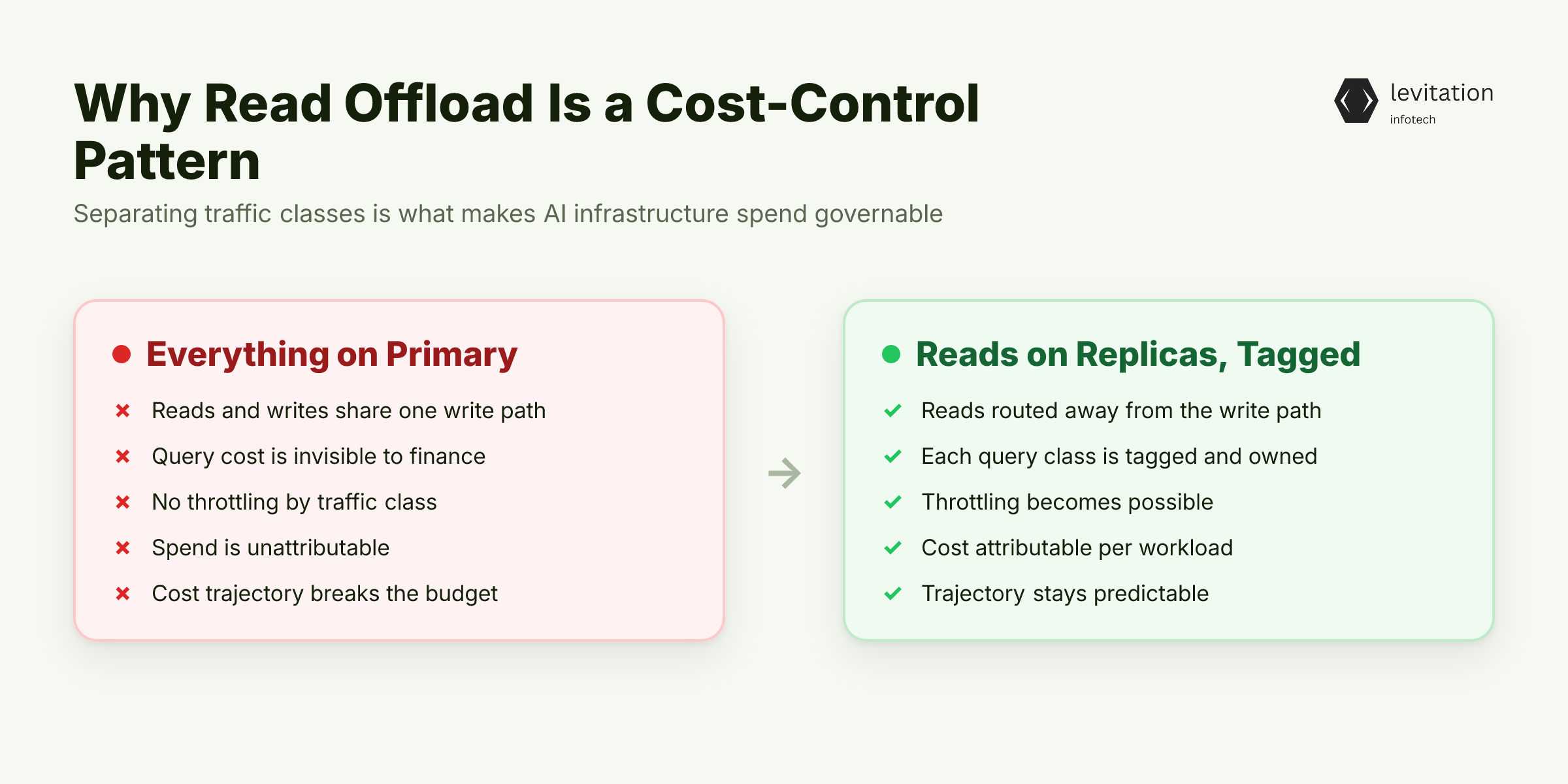
Offloading read traffic to replicas isolates expensive queries from the write path. That sentence sounds like a scaling pattern. It is also a cost-control pattern, and the two are the same thing.
When a query class lives on replicas, you can see its cost. You can throttle it. You can govern it. When it lives on the primary mixed with writes, it becomes invisible noise that finance cannot attribute.
The mechanism is simple. What you can tag, you can govern. What you cannot tag, you cannot budget for.
Scale-Out Reads and Analytics Offload are the two strategies that let PostgreSQL handle large-scale AI workloads without exploding database management cost. Scale-Out Reads means horizontal read capacity behind a routing layer.
Analytics Offload means pushing reporting, training-set extraction, and embeddings generation to read replicas. These workloads never touch the write path. Both work because they create a clean boundary between traffic classes.
That boundary is what most AI platform deployments lack. They let everything hit the same primary. Then they wonder why the cost is ungovernable.
The same pattern shows up in the hidden cost killing fintech AI scaling: ungoverned traffic class becomes ungoverned spend. Finance only sees the result.
The deeper pattern: when you can tag a cost to a specific traffic class, you can govern it. Governance is the missing layer in most AI infrastructure cost models. It is also the layer that, once built, makes the system survive beyond the next budget cycle.
The cost trajectory stays predictable because every line item has an owner.
Knowing the principle is one thing. Building the attribution layer is where most in-house teams stall. Schema design, billing API integration, and governance workflows all have to be built from scratch. Most in-house teams spend a year on this. The right partnership compresses it to months.
The Attribution Layer: Building the Cost Map Your CFO Will Actually Believe
The attribution layer is not a dashboard. It is a tagging discipline enforced at the query layer, not the dashboard layer.
Here is the four-step build that compresses the typical in-house timeline when run by an experienced partner.
Step 1: Tag every workload at the query layer.
Cost has to follow the code, not the cloud bill. Add team, product, and workflow tags to the connection string, the query comment, and the agent execution context.
If the tag is not on the request, finance will never reconstruct it from logs.
Step 2: Separate GPU compute from token spend.
These are different cost lines with different owners. GPU compute is infrastructure. Token spend is product. Mixing them in one FinOps view means neither team owns the line item. Unowned costs always grow.
Treat them as distinct line items with distinct owners and distinct alerts.
Step 3: Track vector retrieval and egress as standalone metrics.
Both grow non-linearly as agentic workflows multiply. A vector index that costs little at small scale starts to dominate the bill as query volume grows by orders of magnitude.
Egress across regions compounds the same way. Standalone metrics let you alert on the slope before the bill lands. We covered the mechanism in why vector DBs bleed compliance money and why Indian fintechs miss GPU autoscaling costs. Both follow the same hidden-curve pattern.
Step 4: Build the dashboard before the next billing cycle.
Retroactive attribution is where in-house timelines go to die. You cannot reconstruct tags from logs you did not write.
Ship the tagging layer first, then the dashboard, then the alerts. In that order.
This is the AI implementation strategy that separates teams who ship quickly from teams who spend extended periods arguing about ownership. Teams that skip it keep discovering their AI spend quarterly, in arrears, with no way to explain it.
When this is done right, the in-house build compresses dramatically. Here is what that actually changes.
What a Streamlined AI Infrastructure Cost Overhaul Actually Changes
Finance can forecast AI spend monthly instead of discovering it quarterly. The CFO conversation shifts from damage control to capacity planning. That alone is worth the build.
Engineering stops arguing about who owns which line item. The attribution layer makes ownership self-evident, because every cost has a tag and every tag has a team. Cost disputes die because the data ends them.
Governance stops being theoretical. Cost anomalies trigger alerts tied to specific teams, not anonymous dashboards. A spike in vector retrieval from the support agent triggers a Slack to the support team's lead. It does not become a finance ticket that sits in a queue.
The long-term shape matters too. Forecasts sharpen every quarter as historical tags feed planning.
That is how teams earn the right to be trusted with enterprise AI systems at scale. The work does not end at deployment. It compounds.
Frequently Asked Questions
Q: Why did OpenAI choose PostgreSQL with a single primary instead of sharding for 800M users?
A: OpenAI scaled PostgreSQL with one primary writer and multiple read replicas rather than sharding. The single-primary model isolates expensive read traffic and write storms. This makes cost attribution and incident response simpler than a sharded topology would allow at that scale.
Q: What is the biggest hidden cost in AI infrastructure beyond LLM token pricing?
A: GPU compute is typically the largest hidden line item. Vector database retrieval, storage growth, cross-region egress, and agentic amplification follow. Agentic amplification is the cost multiplier when autonomous agents make multiple model calls per user action. For most production workloads, these combined layers exceed the visible token bill.
Q: How long does it take to build an AI infrastructure cost attribution layer?
A: A working attribution layer (workload tagging, per-team cost dashboards, and FinOps integration) typically takes months when built with an experienced partner. In-house teams that have to design the tagging schema, integrate billing APIs, and build governance workflows from scratch often spend a year or more.
Q: Should an enterprise move from proprietary to open-source databases to cut AI infrastructure cost?
A: Not by default. Open-source databases like PostgreSQL eliminate license fees but increase operational overhead and talent dependency. The right question is whether your team can isolate read traffic, offload analytics, and maintain the operational discipline OpenAI demonstrates. The savings come from architecture, not from the license model alone.
Q: What is agentic amplification and why does it inflate AI infrastructure bills?
A: Agentic amplification is the cost multiplier created when autonomous AI agents make multiple model calls, tool invocations, and retrieval queries to complete a single user task. A chat that costs a fraction of a cent in tokens can cost orders of magnitude more once the agent's full execution graph is priced in. Attribution at the workflow level matters more than attribution at the user level for this reason.
Sources
Research and references cited in this article:
- AI Infrastructure Costs Are Reshaping Capital Planning - Environment+Energy Leader
- AI Cost Statistics 2026: Forecasting, ROI, and Budget Risk - Mavvrik: AI
- 2026 IT Spending and Budget Forecasts: Where Organizations Are ...
- The AI infrastructure boom is coming for enterprise budgets
- AI Infrastructure Costs Are Reshaping Capital Planning
- 7 Ways to Scale PostgreSQL in 2026 (When Each One Breaks)
- PostgreSQL-Compatible Databases for AI at Scale
- PostgreSQL enters its AI era: Run PostgreSQL like a pro in the era of AI and rapid growth | Microsoft Open Source Blog
- Scaling PostgreSQL to power 800 million ChatGPT users - OpenAI
- PostgreSQL Scaling: Achieving High Availability and Performance
- Open‑Source AI vs Proprietary Platforms: Trade‑Offs for Execs
- Total Cost of Ownership (TCO) for AI Projects: Complete 2025 Guide
About the author
Mayank Singh is a software developer at Levitation Infotech, where he builds web and AI-powered applications across the company’s fintech, healthcare, and enterprise projects.