


TL;DR: Final-answer accuracy cannot show whether GraphRAG caused the result. Test graph quality, retrieval reasoning, answer faithfulness, and dependence on causal evidence.
Route each query to the simplest path that survives evidence changes. GraphRAG becomes an auditable deployment control, not a leaderboard choice.
Key Takeaways: - A correct answer can survive removal of the evidence it supposedly used. - Counterfactual mutations expose shortcuts that aggregate scores hide. - Route simple lookups to vector RAG and reserve graph reasoning for structural dependence.
A Correct Answer Can Hide a Broken Graph
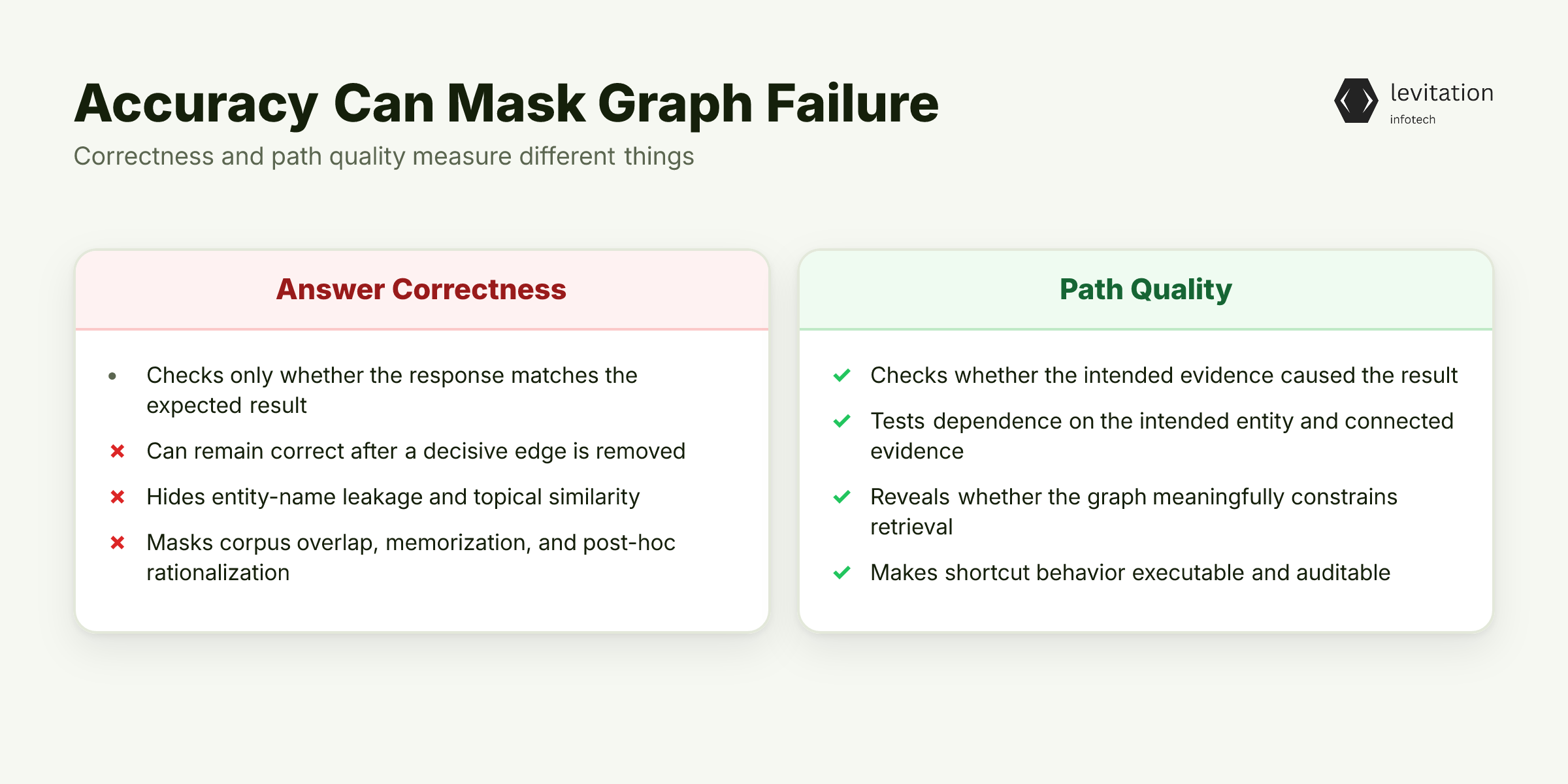
A GraphRAG system can ace a question for reasons the graph had nothing to do with. The model may already know the answer, an entity name may leak its label, or retrieval may take a shortcut.
For a CTO, a green accuracy score that hides this dependency is not retrieval quality. It is an auditability failure waiting to reach production.
The Green-Score Mirage
Final-answer correctness asks whether the response matches the expected result. Path quality asks whether the intended evidence caused that result.
A response can remain correct after you remove a decisive edge. The model may remember the fact, another passage may contain it, or benchmark text may have leaked into training. Correctness hides causal dependence.
Make the shortcut executable:
1{2 "case_id": "medical-entity-disambiguation",3 "query": "What treatment is linked to the mouth-neoplasms entity?",4 "conditions": [5 "full_graph",6 "remove_decisive_edge",7 "replace_with_sibling_entity"8 ],9 "hold_fixed": ["model", "prompt", "decoding", "generation_budget"]10}
Keep everything fixed except the evidence. An unchanged answer then becomes evidence of a shortcut.
The Shortcut Inventory
Spurious correlation has an operational definition: an answer survives after supposedly decisive evidence is removed. - Entity-name leakage: The question or document label identifies the target before retrieval. Substitute a sibling entity. - Topical similarity: Context shares words or concepts but lacks the required relation. Retrieve a contextually close, relationally wrong passage. - Corpus overlap: Another copy supplies the fact. Remove one source copy. - Model memorization: The model already knows the fact. Replace it with a fresh, unseen entity. - Post-hoc rationalization: The model invents a plausible path after reading context. Corrupt the path while preserving source text.
Consider a `mouth-neoplasms` question. A passage about another oral condition is semantically close, so vector retrieval can select it.
A graph should constrain retrieval to the intended entity and connected evidence. Even then, the model may answer from prior knowledge.
In that case, the retrieved passage merely accompanies the answer. Can a final-answer benchmark expose that shortcut?
What the Benchmark Dimensions Reveal
GraphRAG-Bench evaluates fact retrieval, complex reasoning, contextual summarization, and creative generation.
These dimensions cover more outcomes than answer accuracy alone. They still don't reveal which pipeline stage deserves credit. A strong score may come from task choice, graph construction, retrieval, or generation.
That warning matters to AI/ML training teams because a good aggregate score can hide a weak graph. If the answer cannot reveal which stage earned the credit, how can a benchmark compare GraphRAG fairly?
Why a Head-to-Head Benchmark Cannot Assign Credit
Switching from vector RAG to GraphRAG changes more than the retriever. A benchmark can show that one pipeline wins, but not which stage created the win.
The Unfair Comparison
Preprocessing, chunking, entity resolution, graph construction, community summaries, prompts, model settings, and generation budgets can all alter the score.
If one system receives better prompts or a larger generation budget, the comparison no longer isolates retrieval architecture. For fairer comparisons, standardize the corpus, preprocessing, model settings, and generation budget. Follow the approach in the systematic RAG versus GraphRAG evaluation.
1comparison:2 corpus: fixed3 documents: fixed4 model: fixed5 prompt: fixed6 decoding: fixed7 answer_budget: fixed8systems: [vector_rag, graphrag_local, graphrag_global, graphrag_drift]
Without this freeze, GraphRAG may appear better because its surrounding pipeline received better prompts, models, or generation budgets. Reproducibility starts here. Which part created the gain?
Four Attribution Confounders
Four layers can be obscured within one score: - Graph construction: Wrong entities or relations poison later retrieval. - Retrieval reasoning: The system finds related material, not the required path. - Context relevance: Retrieved evidence is semantically close but structurally wrong. - Generation faithfulness: The model ignores evidence or adds unsupported claims.
GraphRAG's Global mode is designed to summarize corpus-wide themes. Graph-oriented benchmarks also test hierarchical retrieval, multihop reasoning, contextual summarization, and creative generation.
A vector baseline may remain competitive on direct fact retrieval. One aggregate score cannot establish universal superiority. This retrieval-versus-decision split echoes RAG Won Retrieval. The Real Enterprise AI Problem Is Decisions.
Mixed datasets and system designs can make benchmark results appear contradictory. Context relevance must be evaluated separately from summary metrics such as final-answer accuracy, as the IEEE evaluation illustrates.
For enterprise AI solutions, a benchmark can establish a system-level performance difference. It cannot prove the graph caused that difference. Once the layers are separated, would the answer survive removal of its supposedly decisive path?
GraphRAG Evaluation Must Test the Causal Chain
Once the layers are separated, the decisive test is intervention. Instead of asking whether the answer looks right, change one part of the evidence and observe what happens.
Layer 1: Knowledge Graph Quality
Measure graph quality before using it to retrieve. Focus on: - Entity-resolution consistency - Relation validity - Provenance coverage - Schema or ontology adherence - Duplicate handling - Freshness where timestamps exist
These checks show whether the graph represents the domain faithfully. A clean retrieval score cannot repair merged entities, invented relations, or missing provenance.
What if the graph itself is sound, but retrieval still selects the wrong subgraph?
Layer 2: Retrieval Reasoning
A retrieval-reasoning test passes only when several conditions hold: - The correct entity is selected. - The returned relation path is valid. - The subgraph contains the minimum sufficient evidence. - Merely related evidence is omitted.
For multihop questions, validate every intermediate hop. A final subgraph can look coherent while a middle edge is invalid.
Valid retrieval still doesn't prove that generation used it. Which claims provide that evidence?
Layer 3: Answer Faithfulness
Faithfulness asks whether generated claims follow from the retrieved evidence. Measure: - Correctness - Completeness - Claim-level citation accuracy - Refusal when evidence is insufficient
Require each material claim to map to source text, graph nodes, and edges. Resemblance to a reference answer is not provenance.
This is the same gap described in Your RAG Citations Aren't Audit Trails. A citation can point somewhere real while failing to support the claim beside it.
The final test must change the graph, not merely inspect it. Will the answer survive that change?
Layer 4: Causal Attribution
Run the same query, model, prompt, and generation budget under four conditions.
1from copy import deepcopy23def build_conditions(graph, decisive_edge_id, sibling_target_id):4 full = deepcopy(graph)5 no_graph = {"nodes": [], "edges": []}67 removed = deepcopy(graph)8 removed["edges"] = [9 edge for edge in removed["edges"]10 if edge["id"] != decisive_edge_id11 ]1213 sibling = deepcopy(graph)14 for edge in sibling["edges"]:15 if edge["id"] == decisive_edge_id:16 edge["target"] = sibling_target_id1718 return {19 "full_graph": full,20 "no_graph": no_graph,21 "remove_decisive_edge": removed,22 "replace_with_sibling_entity": sibling,23 }
Compare generated claims and citations across runs. - An unchanged answer after edge removal indicates a probable shortcut. - A confident answer that remains unchanged after sibling replacement indicates entity confusion. - A qualified or refused answer indicates correct evidence dependence.
An AI/ML training team can treat this as a controlled ablation. For enterprise AI solutions, preserve every run as an audit event.
A causal scorecard only becomes useful when its perturbations resemble real failures. Which production failures should these mutations imitate?
Build a Counterfactual Test Harness Before Production
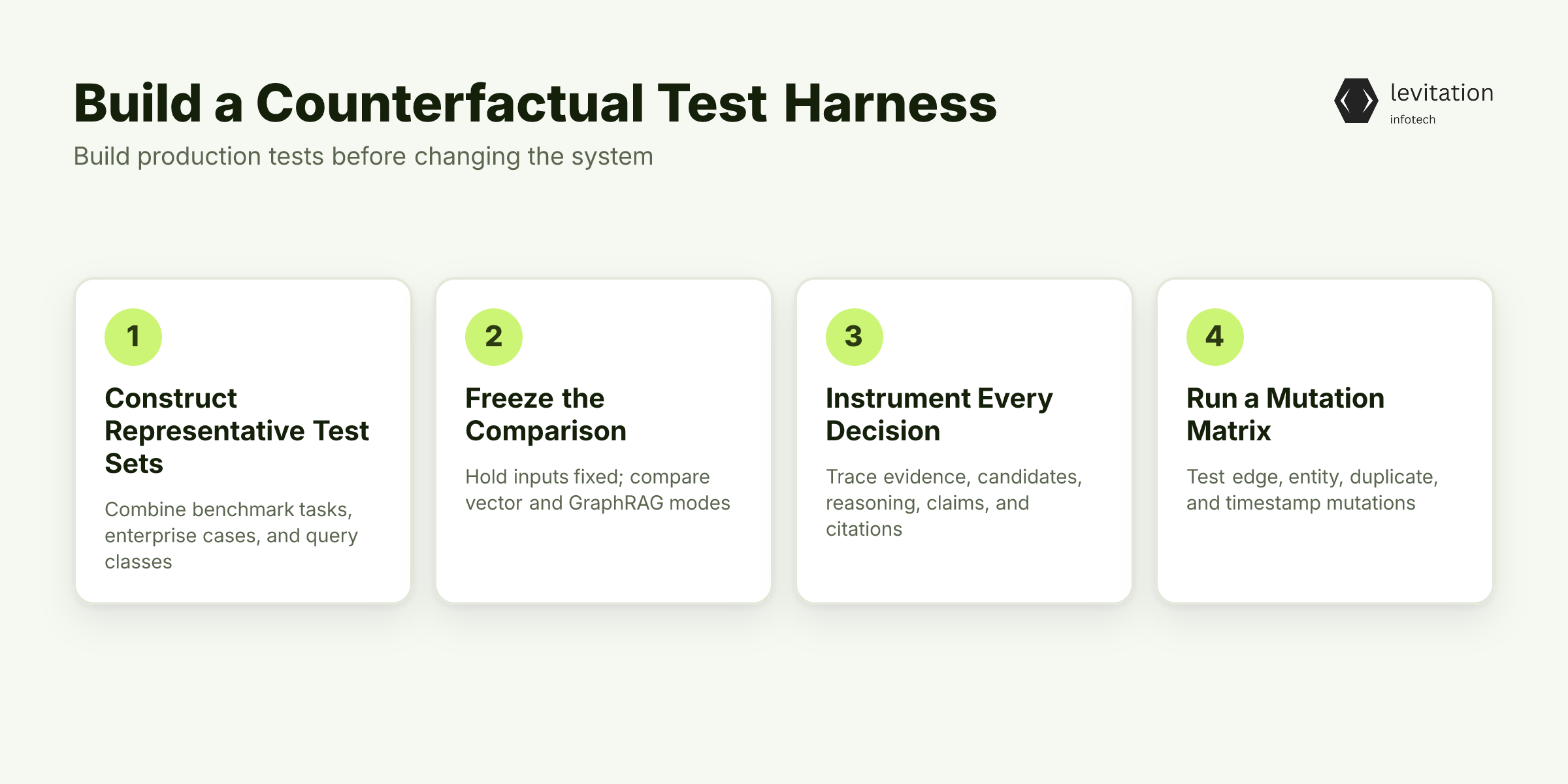
Turn the evaluation into production tests by matching its mutations to the failures your system faces. Build the harness before tuning prompts or expanding the graph.
Step 1: Construct Representative Test Sets
Combine GraphRAG-Bench's fact retrieval, complex reasoning, contextual summarization, and creative generation tasks with enterprise cases.
Enterprise cases should cover direct lookup, entity-specific questions, corpus-level themes, and multihop composition. Include questions answerable without a graph and questions whose correct path requires one.
This prevents a graph-shaped benchmark from proving that every query needs graph reasoning. Which query classes truly need graph reasoning?
Step 2: Freeze the Comparison
Hold the corpus version, source documents, LLM, prompt template, decoding settings, answer budget, and relevant runtime constraints constant.
Compare vector RAG with GraphRAG Local, Global, and DRIFT retrieval. Use the standardized protocol recommended by systematic evaluations.
This matters for AI/ML training, where data, model, or prompt changes can hide architecture effects. Can you still tell the architecture from the pipeline?
Step 3: Instrument Every Decision
Persist the full reasoning trace: - Query interpretation - Retrieved node and edge IDs - Source-document spans - Community reports - Ranking scores and discarded candidates - Reasoning steps, generated claims, and citations
This trace separates missing evidence from ignored evidence. Without it, both failures look like retrieval weakness. Which failure occurred: missing evidence or ignored evidence?
Step 4: Run a Mutation Matrix
1mutation_suite: - {id: remove_edge, operation: remove_decisive_edge, expected: changed_qualified_or_refused} - {id: replace_entity, operation: substitute_sibling_entity, expected: changed_qualified_or_refused} - {id: reverse_relation, operation: reverse_decisive_edge, expected: changed_qualified_or_refused} - {id: insert_duplicate, operation: add_contradictory_duplicate, expected: changed_qualified_or_refused} - {id: alter_timestamp, operation: change_source_timestamp, expected: changed_qualified_or_refused} - {id: relax_ontology, operation: remove_schema_constraint, expected: changed_qualified_or_refused}
The expected behavior isn't simply a lower score. The system should lose confidence, qualify its answer, or refuse when supporting evidence is corrupted. Which mutation best matches the failure you fear in production?
Step 5: Apply Layered Acceptance Gates
Set risk-based gates for graph quality, retrieval relevance, evidence sufficiency, faithfulness, latency, and cost. Compare each result against the frozen baseline.
Don't present universal thresholds as scientifically established. Derive them from the decision cost of each use case.
Even a rigorously tested graph is the wrong architecture for every question. Which reasoning path should each query take?
Route Each Question to the Cheapest Reasoning Path
Even a perfect graph can waste money and latency. Routing turns GraphRAG from a default architecture into a selective capability.
1routes:2 direct_lookup: vector_rag3 entity_relationship: graphrag_local4 corpus_theme: graphrag_global5 broad_to_specific: graphrag_drift
Match Retrieval Mode to Question Shape - Local Search handles entity-specific questions and local relationship paths. - Global Search synthesizes community reports for corpus-wide themes. - DRIFT narrows broad exploration into specific evidence. - Vector retrieval handles straightforward passage lookup.
Measure routing accuracy. Sending every query through the most expensive graph path isn't rigor. It is poor cost control.
Which constraints must each route enforce?
Separate Topology from Semantic Constraints
Topology tells the system how facts connect. Ontology adds constraints about which entities and relations can coexist.
Ontology augmentation can reject semantically similar but structurally invalid relationships during graph construction or retrieval.
Topology and semantic constraints solve different problems. Therefore, evaluate them separately rather than treating either as a universal replacement for the other. What does a structurally invalid path cost in production?
Measure the Cost of Being Wrong
Include these costs in the decision process: - Indexing and graph maintenance - Incremental retrieval latency - Map-reduce expansion - Manual graph repair - Wrong high-confidence answers
The wrong answer can cost more than extra retrieval latency. The infrastructure consequences are detailed in Why GraphRAG Is Burning Your Cloud Credits.
An AI/ML training lead should include routing accuracy in model selection. Use GraphRAG only when a valid structural path measurably changes or supports the answer. Otherwise, prefer vector retrieval and preserve the graph result for audit or later analysis.
The strongest offline score still isn't production evidence. Graph freshness, changing queries, model behavior, and latency can break the causal chain after launch. Can the launch controls preserve that chain?
Turn Evaluation into a Defensible Enterprise Decision
Production starts where offline evaluation stops. A defensible launch converts causal tests into release controls.
Launch with Explicit Gates
Require causal offline tests, source-backed expert review, and a canary release. Monitor graph drift, retrieval relevance, unsupported answers, latency, and cost.
1release_gates:2 required: [causal_tests, source_review, canary]3 monitors: [graph_drift, retrieval_relevance, unsupported_answers, latency, cost]4fallback:5 target: vector_rag6 trigger: evidence_below_policy7 refusal: evidence_insufficient
Define what triggers vector-RAG fallback or refusal. A confident answer without adequate evidence isn't a successful fallback. How will reviewers verify that fallback?
Ship an Audit Package
For each material answer, preserve: - Corpus and graph versions - Schema and ontology - Retrieved subgraph and source path - Generated claims and citations - Model settings - Mutation-test results
Reviewers must follow evidence from question to answer. This requires more than plausible-looking traces, as Task-Aware AI Compression Can Break the Audit Trail demonstrates. Can the package prove the architecture was necessary?
Make the Architecture Decision Explicit
Use vector retrieval for simple lookup, Local GraphRAG for entity relationships and multihop paths, and Global or DRIFT for corpus-wide questions. Add a router for mixed workloads.
The target is not maximum GraphRAG usage but minimum complexity for a defensible answer. Can the release evidence prove that choice?
Present the Payoff with Credible Context
Tie any deployment claim to the evaluation evidence and the scope that produced it. Distinguish graph-specific gains from model, prompt, corpus, and routing effects. Then choose the smallest architecture that can defend each answer. Which failures would justify the added complexity, and which should send a query back to vector retrieval?
About the author
Mayank Singh is a software developer at Levitation Infotech, where he builds web and AI-powered applications across the company’s fintech, healthcare, and enterprise projects.