


An AI-assisted image review begins with a narrow consent scope. By the time the model answers, notes, labs, waveforms, and derived features have entered the run. No record shows that wider exposure.
That gap leaves teams unsure what the model consumed. Sensitive data crosses the permission boundary before anyone sees the mismatch. How do you close it before inference?
TL;DR: A consent record describes permission, while a multimodal model consumes images, notes, labs, waveforms, context, and derived features. Close the gap with executable data lineage, machine-readable consent, runtime decisions, and immutable inference manifests working as one control system.
Key Takeaways: - A consent ledger records permission; it does not reveal the model’s effective input set. - Two linked graphs turn consent and lineage into an execution decision. - Every inference needs a reproducible manifest, runtime enforcement, and failure testing.
The Consent Record Is Not the Model's Input Manifest
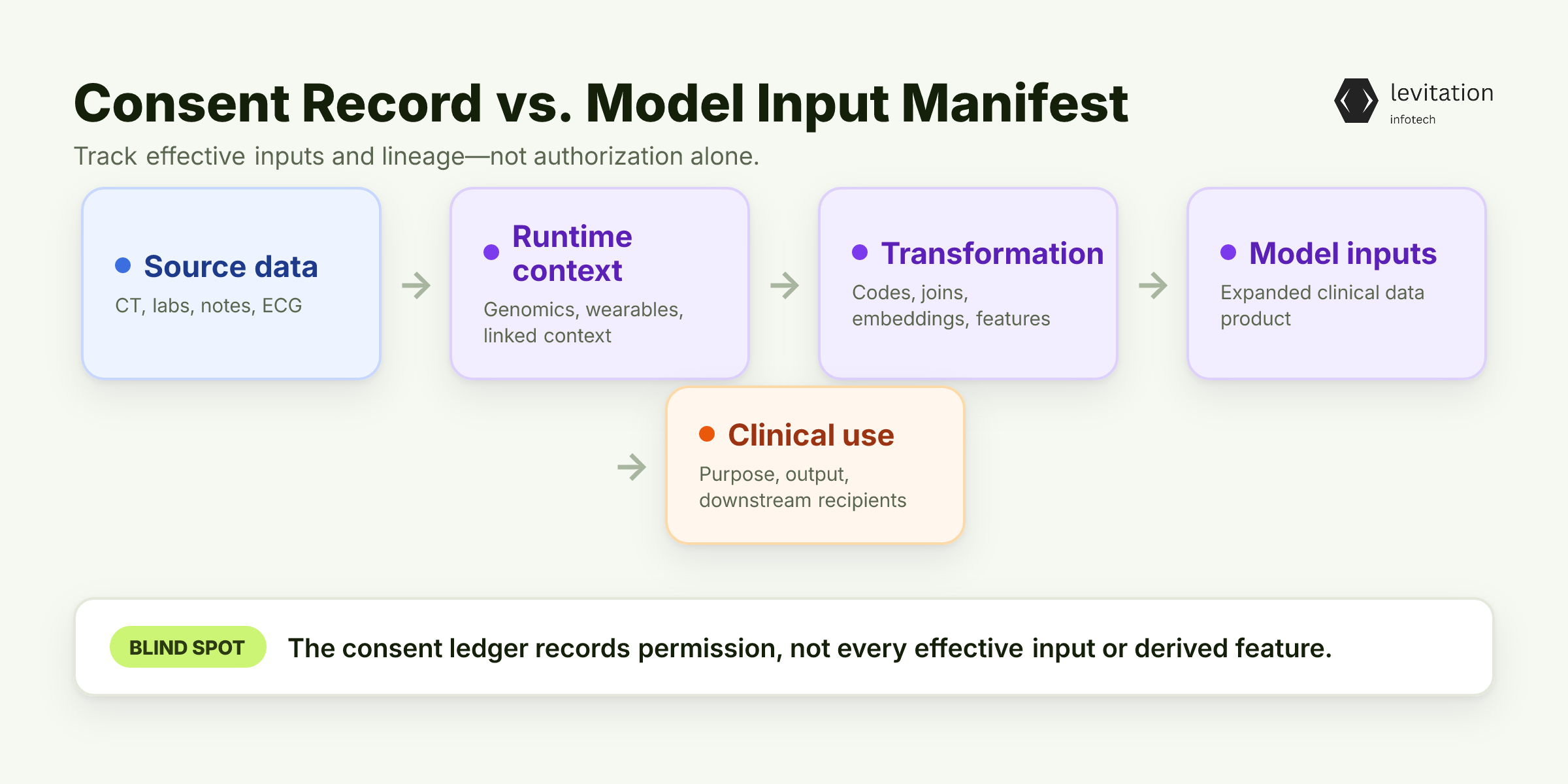
The danger is not only whether consent failed. The design also leaves no consent artifact able to reveal the full exposure. Which reality does the ledger hide?
Two Ledgers Describe Different Realities
Imagine a chest CT reviewed with laboratory results, a clinical note, and a prior ECG. The consent ledger says who authorized what, for which purpose, and when.
The model’s effective inputs tell another story. The runtime expands that set with genomic data, wearable outputs, and time-linked context.
A record permits imaging for diagnosis. The runtime adds other modalities under a general workflow rule.
Nothing is technically wrong. The control surface is blind.
For healthcare technology teams, this is control blindness, not an assumption that every transformation creates a new legal permission.
Legal sufficiency varies by use, jurisdiction, and institutional policy. The ledger alone cannot settle that question. How does the blind spot widen when raw data becomes a derived feature?
Derived Data Expands the Blind Spot
Georgetown Law’s analysis shows how detailed EHR notes and lab values feed NLP systems. These systems extract coded vocabularies, turning a narrow patient event into a richer clinical data product.
The richer product feeds risk scoring, cohort selection, or later inference without another visible consent entry.
Do not assume every transformation needs separate permission. Do assume governance needs lineage across each transformation.
Even when the original permission covers the clinical use, the system fails to explain what the patient event became.
Map one live workflow across six columns: - Source data: Which assets entered the workflow? - Transformation: Which codes, joins, embeddings, or features changed them? - Model input: Which results reached inference? - Clinical purpose: Why did the model run? - Output: What did it produce? - Downstream recipient: Who received or used that output?
Assign every untraced field to an owner. This is not mere paperwork. The missing lineage determines which governance controls can work. Which controls still work when model context no longer matches any consent record?
Why a Consent Checkbox Cannot Govern Multimodal Inference
A checkbox names a permission boundary. A model runtime quietly assembles a context boundary. How does that mismatch weaken consent?
Consent Is Scoped, but Model Context Is Not
Consent names a data category or interaction. In a multimodal workflow, the runtime combines that data with other modalities and temporal context.
Imagine a note authorizing image review for diagnosis. The gateway adds labs, prior ECG data, and recent wearable readings because that configuration is the clinical default.
The system remains clinically useful. The patient still cannot see that extra context shaped its answer.
Permission exists. Patient understanding does not. How does hidden context weaken informed consent?
Invisible Operation Weakens Informed Consent
Georgetown Law’s analysis notes specialist-level performance in many diagnostic tasks and better prognosis prediction than clinicians in some areas.
It warns that this complexity makes it hard for patients to judge how AI applies to their case. The analysis points to model opacity and operation without conversational checks.
Lawsuits involving AI-enabled visit recording show the disclosure risk when notice or consent is unclear. They do not establish a universal rule for every clinical AI use.
The same trust problem appears in why patients and clinicians distrust clinical AI. How does constant, confident output add another risk?
Confident Systems Can Outsource Judgment
Constant, confident AI output shifts judgment toward the system. Repeated reliance weakens independent diagnostic judgment.
A radiology model must reveal when notes and images conflict. It must expose uncertainty instead of smoothing disagreement into false certainty.
Governance must interrupt the run before exposure, not after the answer.
Divide AI governance into five enforceable control points: - Collection: Verify the approved data class before retrieval. - Transport: Preserve patient, purpose, and authorization context. - Inference: Evaluate the requested context before combination. - Disclosure: Record display, export, and downstream sharing. - Secondary use or retention: Require a distinct purpose and expiry.
Give each stage an owner and a measurable control. Another checkbox will not work. What must the control system record to show exactly what the model consumed?
Build a Data-Lineage Graph That Models Can Execute
Tracing a DICOM study to its scanner proves origin. It does not prove what the model saw. A source map still leaves a critical gap.
Source Lineage Is Necessary but Insufficient
Source lineage answers where an asset came from. It doesn’t answer what happened next.
A final recommendation draws on inputs such as temporal joins, embeddings, retrieved snippets, derived codes, feature transformations, and external tools. The original asset stays traceable while the effective model input remains opaque.
This is the same contract failure described in Your Model Didn’t Break. The Feature Contract Did..
A source graph is necessary. It is not a model input manifest. How can two graphs close that gap?
Link Two Graphs Instead of Isolated Spreadsheets
Build both chains and connect them at runtime: - Data-lineage chain: Source to transformation to feature to model to output. - Consent-lineage chain: Purpose to authorization to scope to expiry to policy to runtime decision.
Make shared vocabulary a requirement for daily use.
Use canonical feature identifiers, versioned transformations, and an internal ontology. Every modality needs the same control vocabulary, even when its clinical meaning differs.
One graph tells you what happened. The other tells you whether it was allowed. How can that link operate at runtime?
Make the Graph Operational
Before execution, resolve the patient, purpose, requested features, consent scope, and policy version. Then attach that decision and the effective input set to the model run.
Define the minimum contract across the EHR, consent service, feature store, model gateway, and output interface. Every edge carries an owner, timestamp, version, and machine-readable reason.
This replaces the spreadsheet approach described in your AI control plane is a spreadsheet. For healthcare technology teams, it also turns HIPAA-related data lineage into a control dependency rather than a report.
Connect both graphs through AI governance. Once lineage becomes an execution input, consent stops being after-the-fact paperwork. It becomes a runtime decision.
But a runtime decision still needs proof. Which record can reconstruct the exact inference after the event?
Instrument Every Inference with a Reproducible Run Manifest
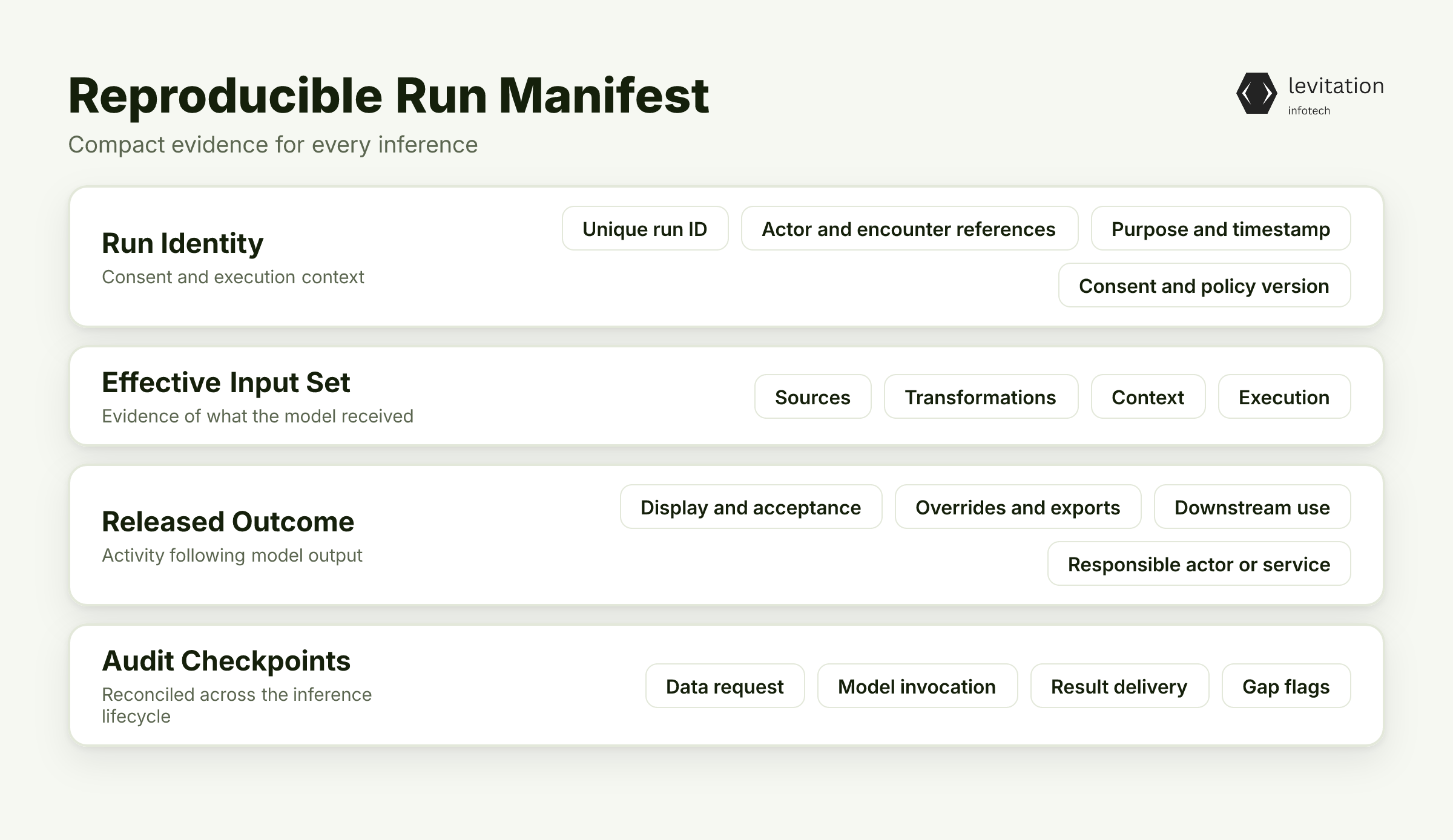
After an adverse event, the first question is simple: what did the model actually receive?
Treat the Run Manifest as the Effective Consent Receipt
Assign every inference a unique run ID. Record the actor, patient and encounter references, purpose, timestamp, consent decision, policy version, and approved data classes.
This manifest describes one run. It does not replace the complete clinical record or create legal permission. What must it capture to prove the effective input set?
Capture What the Model Actually Received
The manifest must capture four categories: - Sources: Asset IDs, modality types, versions, and observation timestamps. - Transformations: Extractions, joins, embeddings, derived codes, and feature versions. - Context: Retrieved snippets, feature IDs, missing modalities, and external tool calls. - Execution: Model version, prompt or template version, and permitted input set.
Keep the record compact enough for automatic emission by an EHR or model gateway. It must remain queryable, immutable, and reconciled against platform events.
Free-text annotations cannot reliably reveal an unregistered feature or an unlogged modality.
An output without this evidence is difficult to reproduce or defend. How should the manifest track what happens after release?
Capture What Happened Next
Connect every output to the run ID. Record whether it was displayed, accepted, overridden, exported, or used in a downstream workflow.
Name the responsible clinician or service. Record any escalation, rejection, or follow-up action.
Reconcile activity at three checkpoints: - Data request: Which assets were requested, and under which decision? - Model invocation: Which registered features and tools actually ran? - Result delivery: Which output appeared, changed, or moved downstream?
Flag outputs with no run ID, unlogged modalities, missing consent decisions, and unmatched transformations. The gaps highlighted in clinical AI inference logs show why activity records alone aren’t enough.
A complete audit trail enforces nothing on its own. How can policy interrupt inference before sensitive data is combined?
Turn Consent and Governance Policy into Runtime Controls
Policy buried inside a prompt influences an answer. It cannot reliably prevent unauthorized retrieval. Where can the system stop it?
Put Policy Before the Prompt
Enforce consent and clinical governance in data retrieval and the model gateway. These layers support withholding, substitution, or escalation before data moves.
Policy must sit before the prompt, where it can stop data movement. What should that decision contain?
Define a Machine-Readable Decision Contract
Evaluate the purpose, authorization status, consent scope, permitted data classes, expiry, revocation state, clinical-use category, and policy version.
Return one explicit outcome with a reason code: - Allow: The requested input set is permitted. - Deny: A required condition fails. - Degrade: Only approved modalities can run. - Escalate: The case needs human review.
The runtime sequence is straightforward: validate the patient, encounter, purpose, and requested modalities, then resolve consent and policy versions.
Build the permitted input set and record exclusions. Execute or route the case. Write the decision into the run manifest before releasing any output.
Avoid blocking every request by default. Degrade to approved modalities, abstain, or route for human review when policy permits. Define emergency pathways separately instead of improvising them during an incident.
Separate direct-care permission from research, model training, vendor reuse, and other secondary purposes. Authorization for one workflow never covers another by default.
The runtime now has an enforceable order. Which failure cases will prove it works under pressure?
Test Governance Under Clinical Failure, Not Just Model Accuracy
Model accuracy is the easy test. It says nothing about what happens when consent expires during an overnight workflow. What should the test pack cover?
Build a Clinical Failure Test Pack
Exercise these conditions before release: - Missing modalities - Stale or revoked consent - Conflicting authorization - Out-of-scope secondary use - Emergency access - Inconsistent source data - Model and feature updates - Human overrides
Use a concrete scenario. The ECG service fails while a combined imaging recommendation is requested. The system logs the missing modality and runs with an approved subset only when policy allows. Otherwise, it abstains or escalates.
Prediction accuracy cannot tell you whether those controls hold. How should release evidence reflect those controls?
Set Release Gates on Evidence, Not Accuracy
Score clinical safety, lineage completeness, policy enforcement, reliability under modality loss, fairness across relevant populations, and the quality of human oversight.
Every release requires a traceable manifest and attached consent decision. The release also requires a recorded clinician or service action. Test the rollback path when model or feature versions change.
Evaluate production governance when hospital AI pilots move beyond controlled demonstrations. Production governance is an operating control, not an annual document.
When comparing top AI companies for healthcare in India, assess operating history, compliance evidence, and production controls alongside model benchmarks.
Incident analysis then becomes reconstruction rather than conjecture. Can the system prove what it blocked, not just what it shipped?
Frequently Asked Questions
What is multimodal clinical AI?
Multimodal clinical AI combines images, notes, labs, waveforms, and genomic information. It supports diagnosis, prognosis, monitoring, and treatment decisions. One output draws on several data sources with different permissions.
How can a hospital audit which data a multimodal clinical AI used?
Require an immutable run manifest for every inference. Record source assets, transformations, feature versions, model and prompt versions, consent decisions, and outputs. Correlate that manifest with EHR and feature-platform events to detect missing or unapproved inputs.
Does HIPAA require consent for every clinical AI use?
HIPAA does not impose a universal consent requirement for every clinical AI application. It governs specific uses, disclosures, safeguards, and access obligations. Other rules depend on applicable law, institutional policy, and the workflow, so privacy counsel must validate each control design.
Can one patient consent cover reuse of clinical data for AI training?
Do not assume so. Document direct-care consent, research authorization, model-training permission, and vendor reuse as distinct purposes with defined data scope, retention, and revocation terms.
Must a multimodal model receive every available patient data type?
No. A model runs with an approved subset of modalities when full coverage is unavailable. Log the absence of each input and whether the system degraded, abstained, or imputed before producing an output.
Which release gate will you test first: a degraded output, abstention, or escalation?
About the author
Mayank Singh is a software developer at Levitation Infotech, where he builds web and AI-powered applications across the company’s fintech, healthcare, and enterprise projects.