


TL;DR: Edge inference determines where AI runs, but it does not ensure every device gives the same governed answer. Version the full answer contract: model, runtime, prompts, knowledge, policy, and tools. Route local and cloud requests through that contract. Release and audit the stack as one unit.
Key Takeaways: - A model version can't prove fleet consistency when knowledge, policy, prompts, and tools also drift. - A signed answer contract and response envelope make every result traceable to its source state. - Local-first routing works only when cloud fallback follows the same policy and metadata rules.
Local Inference Does Not Mean Consistent Answers
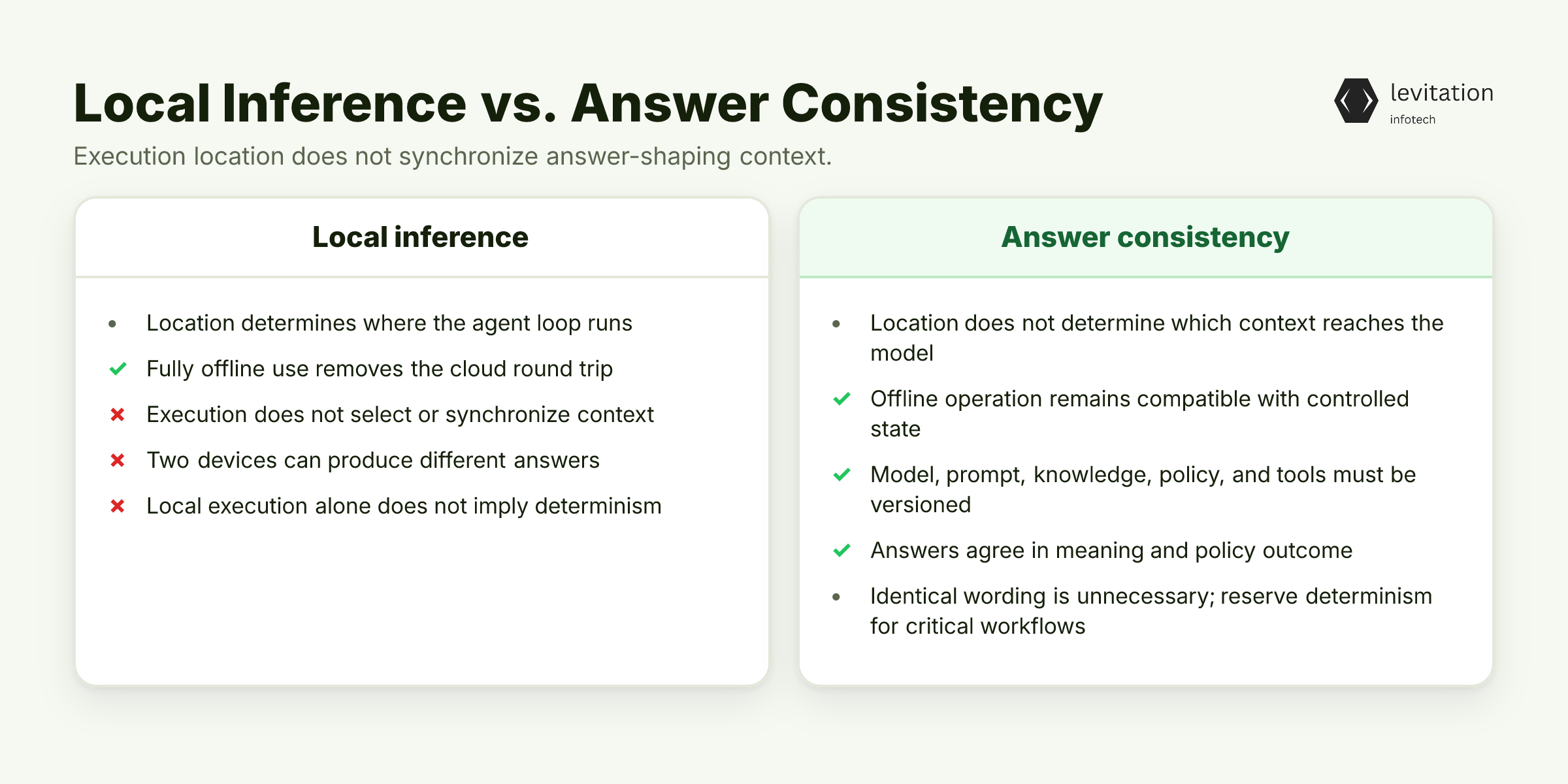
An edge AI agent can be fully offline, yet two devices can still give different answers to the same enterprise question. Moving inference to the edge removes the cloud round trip from the request path. It does not synchronize the models, prompts, knowledge, policies, or tools that determine what the agent says.
The false equivalence
Local execution decides where the perception, reasoning, and action loop runs. It improves offline availability and removes cloud dependency from the request path. It does not decide which context reaches the model.
Imagine two field devices receiving the same work-safety question. Both run on-device. One retrieves the current procedure. The other uses an older local index.
Same location. Different reality. Which device reflects the enterprise's current reality?
The consistency gap
The same request can produce a different result when any piece of hidden state changes: - A different model build or runtime changes response behavior. - A changed system prompt or site instruction changes the task. - A stale retrieval index changes the facts. - A newer policy changes what the agent may do. - A different tool result or cloud route changes the action.
AI answer consistency means agreement in meaning and policy outcome. It does not require byte-for-byte identical wording. Two devices can phrase answers differently while sharing the same evidence and policy outcome.
Reserve deterministic behavior for safety-critical workflows and repeatable tool calls.
The CTO diagnostic must change. Asking whether an agent answered locally is insufficient. Ask which versions of the model, knowledge, prompt, policy, and tools produced it.
Enterprise AI solutions need an operating model that makes every answer explainable and reproducible across a distributed fleet.
Once these hidden state surfaces are visible, a deeper problem emerges. Which ones drift first across your fleet?
The Four State Surfaces That Drift Across Devices
Model and runtime drift
A model family name is not a release. Quantization, runtime version, inference settings, and hardware kernels can alter behavior across devices. CPUs, GPUs, and NPUs handle the same weights differently.
Small output changes can then alter tool selection or confidence.
This is why a quantized LLM can become hard to audit. "Local model" hides too much state. Which other state can drift while that label stays the same?
Knowledge snapshot divergence
Offline retrieval turns local storage into part of the answer. Incremental indexing, failed synchronization, and delayed deletion can leave each device with different source material.
Picture a head-office policy change. A remote device still retrieves the previous reimbursement limit. Its model can be current, but its answer is not.
Which context and tool versions complete that record?
Context and tool divergence
Device-specific instructions, user permissions, site configuration, tool schemas, API versions, and live responses all shape the result. A tool-call format change can be as disruptive as a model upgrade.
This is the same audit gap seen when an agent's tool call leaves the trail dark. Cloud fallback can widen that gap. Which tool and configuration versions caused the divergence?
Cloud fallback ambiguity
Cloud escalation must be explicit. Otherwise a local answer and a cloud answer can use different models, indexes, and policies. The user sees one service, but the enterprise operates two competing sources of truth.
Which route versions expose that split before users do?
Expose drift before users do
Build a fleet-state inventory with four surface groups. Track each group separately: - Model and runtime: build, quantization, runtime, last synchronization time, and owner. - Knowledge: snapshot identifier, synchronization time, expiry, and index owner. - Context and tools: configuration version, API version, and tool owner. - Cloud fallback: route policy, cloud release identifier, and escalation owner.
Autonomy raises the stakes. AI agents can change data or invoke actions, not merely return text. Context drift can therefore become an operational incident.
Shipping a newer model update cannot solve this alone. The fleet needs a contract that remains trustworthy through partial connectivity and staggered rollouts. What must that contract version?
Version the Answer, Not Just the Model
One signed release artifact
Define the answer contract as five coordinated versions: - A model manifest covering the exact build, quantization, and runtime requirements. - A prompt and runtime configuration covering instructions and inference behavior. - A knowledge snapshot covering corpora, indexes, and embeddings used for retrieval. - A policy version covering permissions, escalation, and prohibited actions. - A tool-schema version covering callable interfaces and expected responses.
Package these versions into one signed manifest. Include checksums for artifacts and compatibility rules for each device class. Each device can then show which complete configuration it runs.
This closes the gap highlighted in the feature contract failure pattern. The model may be healthy while the surrounding contract is broken. How can operators see that broken contract in each response?
A common response envelope
Record the same metadata with every response: - Request ID and execution route. - Signed release identifier, model, runtime, prompt, knowledge, policy, and tool versions. - Evidence or source references. - Confidence signal and policy outcome. - Fallback state and timestamp.
This envelope separates model output from decision context. It also lets operators reconstruct the decision path without storing unnecessary sensitive content.
Treat confidence as a calibrated signal, never as evidence. How should teams judge residual uncertainty?
Consistency tiers, not false precision
Set expectations by task: - Advisory questions require equivalent policy outcomes. - Knowledge questions require grounded factual agreement. - Critical tool calls require deterministic output and policy gates. - Missing or stale evidence requires explicit uncertainty or abstention.
These tiers separate useful consistency from pointless wording uniformity. What keeps the shared evidence fresh on every device?
Edge knowledge is a lifecycle, not a cache
Edge knowledge management validates, versions, distributes, synchronizes, and retires local corpora, indexes, and embeddings. Device storage isn't a file cache. It is governed enterprise state.
Which decisions may that state authorize locally?
Separate inference from decision authority
An edge agent can infer locally while high-risk decisions pass through an approved policy gate or authoritative cloud service. Enterprise AI solutions should let local and cloud routes coexist without creating competing truths.
Once every answer carries the same versioned contract, local and cloud execution become one system. They no longer compete as separate architectures. How should one contract govern both routes?
Route Local First Without Creating a Second Brain
Classify the request before inference
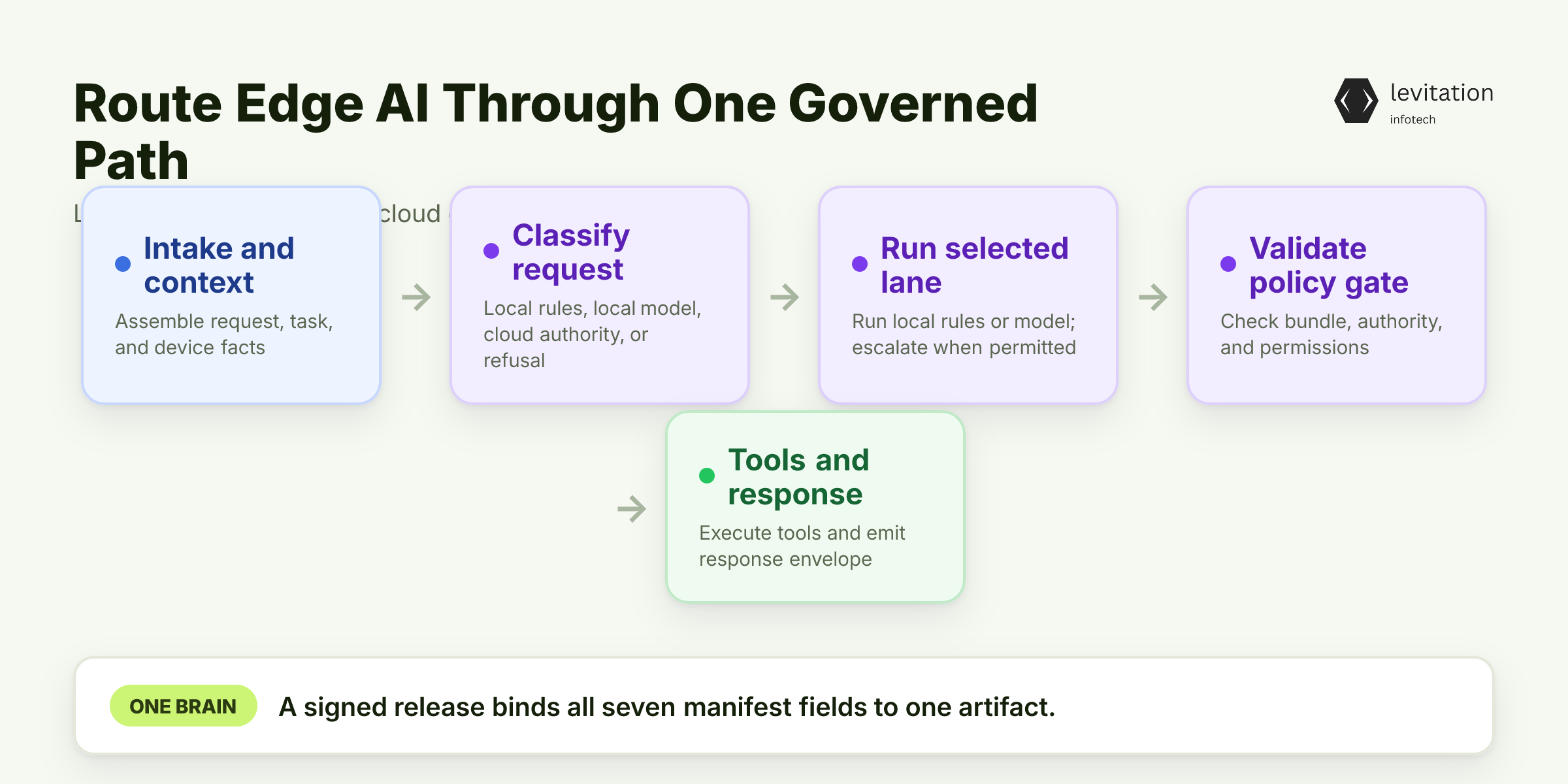
Use four routing lanes: - Deterministic local execution: approved rules and tools; exits after a repeatable result or failed precondition. - Local model execution: supported, permitted, and fresh; exits after a confident result or an explicit escalation request. - Cloud-authoritative execution: required authority or ability is missing locally; exits through the same policy gates and response envelope. - Prohibited processing: the request or data is disallowed; exits with refusal and an audit event.
Route on task sensitivity, device capability, model support, connection quality, knowledge freshness, and confidence. Never route silently because cloud access happens to be convenient. How does each request move through these rules?
Reference execution flow
The governed flow is: `input -> context assembly -> model inference -> policy gate -> tool execution -> response envelope`.
If escalation is allowed, the cloud repeats the governed path and emits a replacement envelope.
A compact JSON manifest can carry seven fields, but every field needs a validation rule: - model_id must match an approved model variant for the selected route and device profile. - runtime must pass the release's compatibility checks. - prompt_version must match the approved instructions and configuration for the selected route and device role. - knowledge_snapshot must exist, pass integrity checks, and remain inside its validity window. - policy_version must be active and approved for the device's role. - tool_schema_version must match deployed tools and approved API versions. - cloud_fallback must state whether escalation is allowed, required, or prohibited.
The signed release identifier binds all seven fields to one artifact. Which devices can actually run this bundle?
Realistic hardware boundaries
Local model memory use depends on model size, quantization, context length, and runtime overhead. GPU or NPU acceleration helps, but it isn't mandatory. Evaluate Jetson, Coral, and Apple Neural Engine against the actual workload.
Memory pressure, thermal limits, supported operations, and tool-call reliability matter more than the label on the box.
Local and LAN-hosted runtimes can support offline retrieval and tool use. They aren't automatically on-device execution. A cloud control plane also doesn't make cloud inference local.
Report the actual route. What happens when that route loses its cloud control plane?
Offline behavior
Continue approved local tasks. Display the active knowledge snapshot's freshness. Block stale, high-risk actions.
Queue noncritical updates. Never fabricate an unsupported answer.
Every cloud fallback must pass the same policy and response-envelope rules. Escalation changes what the system can do, not the enterprise's answer contract.
This routing model will remain consistent only if release engineering treats the model, prompt, knowledge, policy, and tools as one deployable unit. How should that unit ship?
Ship Knowledge and Models as One Governed Release
Build a coordinated CI/CD pipeline
Create, test, sign, approve, distribute, activate, and retire the model, runtime, prompt, index, policy, and tool schema as one release bundle.
A model update without its matching runtime, prompt, knowledge, policy, and tool schema is an incomplete release. How can teams prove the complete bundle agrees?
Test semantic agreement across hardware
Maintain a golden-query suite that compares policy outcomes, factual grounding, tool-call correctness, abstention behavior, and response metadata across representative devices and runtimes. Compare meaning and decisions, not decorative phrasing. Where should that proof run first?
Roll out in stages
Use canary devices and staged percentage rollouts before fleet-wide activation. Roll back automatically when compatibility, critical-task checks, or policy checks fail.
Existing canary deployment pitfalls also apply to edge fleets, especially when devices reconnect at different times. How should synchronization survive those reconnections?
Design for intermittent networks
Use full snapshots for small stores and incremental updates for large indexes. Give every snapshot a monotonic version.
Use tombstones for deletions. Set explicit expiry for stale knowledge.
A device must know that partial synchronization isn't complete synchronization. Which release states should operators see?
Instrument versions, not just errors
Record model, knowledge, policy, and tool versions beside route, response time, confidence, fallback rate, and policy outcome. Collect metadata rather than unnecessary raw sensitive content.
Apply AI governance through named owners, approval gates, change records, exception handling, audit exports, and rollback authority.
Model documentation alone can't provide those controls. Which fleet measures show whether those controls work?
Delivery planning: A production edge AI program should be scoped around coordinated releases, device compatibility, knowledge distribution, observability, and rollback. An in-house build requires those platform capabilities, not just the agent application.
Once releases, exceptions, and evidence are auditable, consistency becomes an operating capability rather than a one-time model-selection decision. The next question is how to measure that capability across the fleet.
Consistency Turns Local Agents into Governed Systems
Local fast paths stay responsive and offline-capable. Cloud escalation stays authoritative when needed. Every output traces back to the state that produced it.
That is where enterprise AI solutions meet AI governance. The fleet becomes a governed system, not a collection of devices. Which measures show whether the fleet holds that line?
CTO scorecard
Track these measures across the fleet: - Semantic agreement across devices. - Stale-knowledge rate. - Cloud-fallback rate. - Policy-violation rate. - Critical-task pass rate. - Synchronization lag. - Mean and p95 latency.
Governed answer contracts prevent untracked configuration drift. They make incident reconstruction possible. They also let enterprises update knowledge without rebuilding every agent integration.
The decision rule is direct. Run locally when the task is approved, supported, and sufficiently fresh.
Escalate when the device lacks ability, confidence, connectivity, or policy approval. Abstain when neither path can be trusted.
This matters because AI systems don't fail like microservices. A fleet can remain online while producing inconsistent or unauthorized decisions.
Locality is a deployment choice. Consistency is an enterprise design requirement.
Before choosing a route, test whether your fleet can prove which reality produced every answer. What should leaders ask when those measures slip?
Frequently Asked Questions
What is an edge AI agent?
An edge AI agent runs its perception, reasoning, and action loop on a phone, vehicle, sensor, gateway, or other local device. It doesn't send every request to a cloud model.
It can operate offline, but local execution alone doesn't guarantee consistent enterprise answers across devices. That makes consistency a separate design problem. Which parts of the answer contract must stay aligned offline?
Are edge AI agents' answers automatically consistent?
No. Consistency requires coordinated versions of the model, prompts, retrieval knowledge, policies, and tools.
A signed answer contract, fleet-wide evaluation, and controlled synchronization make consistency measurable rather than assumed. Measuring it starts with governing the state behind each answer. What metric should lead the first fleet review?
How do you build edge knowledge management for AI agents?
Treat local corpora, indexes, and embeddings as versioned enterprise artifacts rather than unmanaged device files. Distribute signed releases and validate them before activation.
Synchronize changes incrementally, retire stale content with tombstones, and expose knowledge freshness in every response. Fresh local knowledge does not cover every authoritative decision. Which decisions must remain local when authoritative knowledge is unavailable?
When should an edge AI agent use cloud fallback?
Use cloud fallback when the local device lacks the required ability or confidence. It should also escalate when authoritative knowledge is unavailable locally or policy permits escalation.
The cloud route should use the same response envelope and policy rules. The transition must be logged rather than hidden.
The real risk isn't cloud fallback itself. Silent fallback creates two truths. Which lane should govern each request before a device chooses its route?
About the author
Mayank Singh is a software developer at Levitation Infotech, where he builds web and AI-powered applications across the company’s fintech, healthcare, and enterprise projects.