


TL;DR: A pilot quote of about ₹3 lakh can price a demo. It does not cover the cost of a production system with live data. Separate the prototype, production build, and running costs. Model four cost ledgers. Then test current, peak, and recovery scenarios before you commit.
Key Takeaways: - A proof of concept, production MVP, and monthly operating envelope are separate business products. - Real-time data adds build, movement, context, decision, and operating costs. - Every recurring line needs a unit, rate, owner, and scenario before signature.
The ₹3 Lakh Quote Prices the Demo, Not the Live System
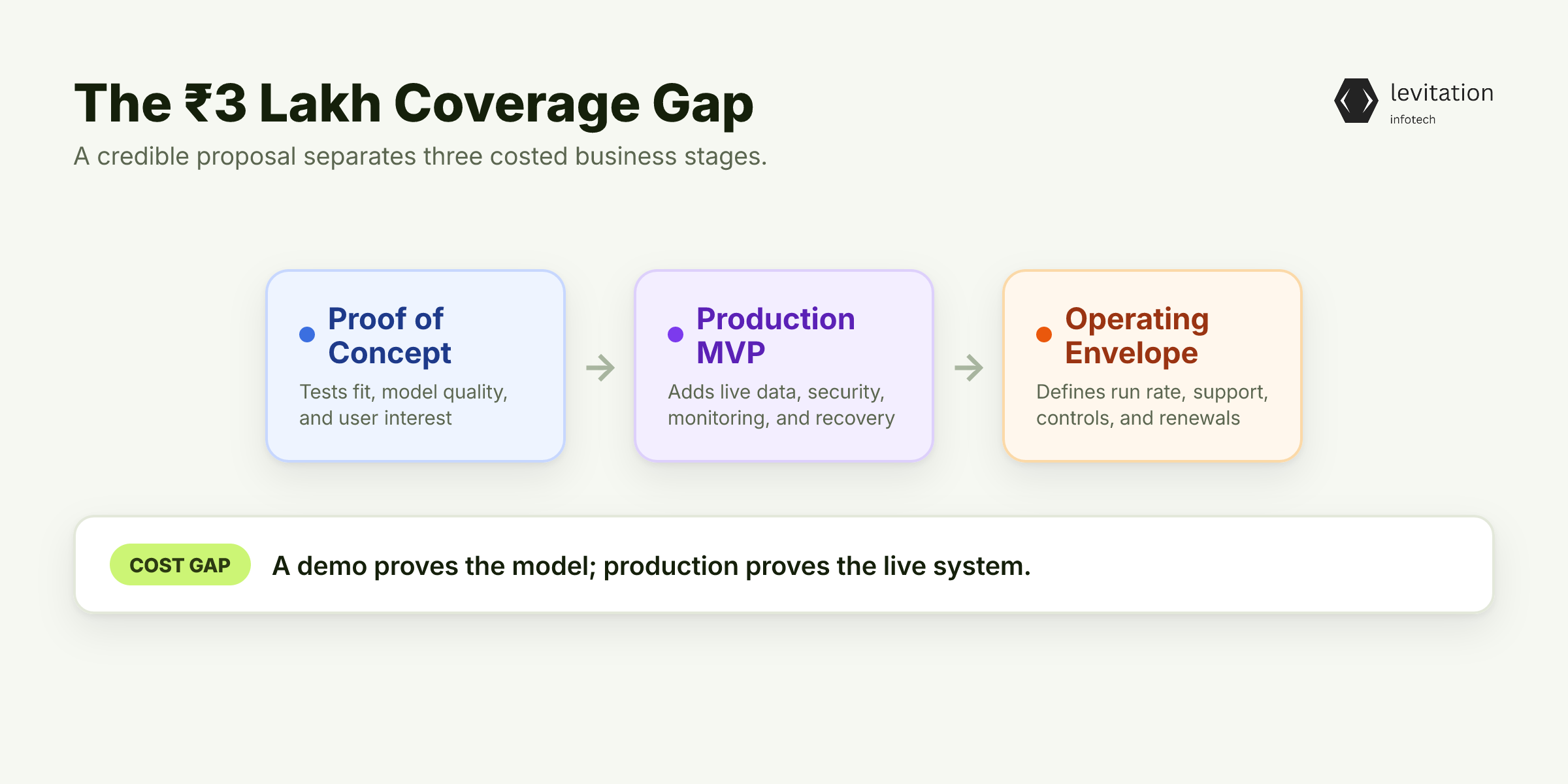
The risky part of a pilot quoted around ₹3 lakh is not what it costs. It is what it proves. A demo with chosen data tests the model. It also hides the live data costs of production.
A prototype tests model quality, interface flow, and user interest. It says little about live connectors, sign-in, monitoring, recovery, or production use. Those gaps remain unless the quote includes these features.
Any sound proposal for AI development services should separate three business parts. The first is a proof of concept. It tests practical fit, model quality, or user interest. The second is a production MVP. It tests a limited workflow with live sources, security, monitoring, and recovery.
The third is an operating envelope. It sets the monthly run rate, support boundary, usage controls, and renewal terms. Buyers often read a quote for the first part as a promise of the second. The gap is easy to miss because the model and interface are visible. Connectors, data contracts, security controls, testing, monitoring, and support often sit outside the quote.
The cost of a live system depends on data readiness and connection depth. Security, deployment, and usage also shape the cost. The model is only one line.
GitHub's shift to usage-based Copilot billing sent a useful warning. It showed how usage pricing can change a software cost. That cost was once easy to predict.
For this reason, the warning belongs in the pilot budget, not after launch. Role-based limits and selective model use keep the cost risk visible.
Cost control also needs an owner. This is why AI pilots often stall on ownership rather than model quality.
If the model is not the biggest line, where exactly does the ₹3 lakh disappear?
Why Real-Time Data Changes the Cost Shape
Upload one clean CSV, and the demo looks free. Connect a live CRM, event stream, and changing warehouse. Then usage-linked charges appear on refreshes.
The batch-data blind spot
Batch data hides four moving parts: source truth, update timing, delivery failure, and downstream response. A static file has no delayed event, expired credential, changed schema, or replay.
Live APIs charge per call. CDC and event streams charge per event or byte. Warehouses and vector stores charge per query.
The sample-data demo hides several critical operations. - Source access needs credentials, token rotation, permissions, rate limits, and sign-in checks for each source. - Data shape needs schema mapping, field validation, payload versions, and data contracts. - Data movement needs ordering, duplicate removal, backfills, retries, replay, and failed-message handling. - Operational control needs freshness checks, monitoring, record matching, and incident records.
Freshness turns a single failure into a running cost. Late events trigger more processing. Duplicate events repeat model calls, tool actions, or human review.
Each source brings its own credentials, payload formats, update patterns, access controls, and failure types. One connector is not a cost unit.
Which ledger absorbs each source and failure?
Price the production unit economics
Monthly data movement grows with events, calls, bytes, and queries. Retrieval grows with queries and context. Decisions grow with actions, retries, and model use.
As a result, these meters become running charges: - Data movement multiplies monthly events or calls by ingestion, processing, transfer, and storage rates. - Retrieval multiplies workflow queries by context size, index refresh work, and database reads. - Decisions multiply tool actions by model usage, validation, and retries. - Operations add logs, monitoring, audit trails, support, and incident handling.
These meters multiply. As a result, failures repeat every costly step.
This is where the hidden TCO of real-time pipelines enters the AI business case.
How should these meters appear in the vendor quote?
Five questions for any estimate
Founders should settle five questions before accepting an estimate.
- How many sources must you connect?
- What does the peak event rate look like?
- What freshness does the workflow require?
- How much context enters each decision?
- What happens when a source is unavailable?
Put these answers into the provider's estimate for AI development services. Split hidden costs into visible lines and lines you can control. This makes the cost drivers easier to handle. Without that split, the estimate remains guesswork.
Which four ledgers should carry those answers?
The Real-Time Data Bill Has Four Ledgers
Once these cost drivers are visible, split the estimate into four ledgers. A support assistant looks cheap until every answer reads fresh cases. It then retries a failed action and leaves an audit trail.
Ledger 1: Build and integration
Treat source discovery, connector work, authentication, and schema mapping as one-time build work. Also include data contracts, test environments, permissions, and work that is ready for production.
Call it one-time, but not fixed. Each new source or schema change reopens the work.
Which recurring charges follow this build work?
Ledger 2: Data movement
Track API calls, CDC operations, event ingestion, stream processing, queues, backfills, replays, data transfer, and short-term storage. Record each as recurring or usage-linked.
Use provider rate cards because each service uses a different unit and rate.
Which context charges follow the movement?
Ledger 3: Context and retrieval
Price index refreshes, embeddings, chunking, vector or relational queries, context reads, storage, and live knowledge updates.
Even when the model chooses the context, the pipeline still pays to prepare, retrieve, and refresh it.
How do decisions and operations fit the same model?
Ledger 4: Decisions and operations
Include model tokens, tool calls, validation, retries, downstream actions, system monitoring, audit logs, human review, and incident support.
Failures also appear here. A retry creates a new model call and another action.
Keep fixed commitments separate from costs tied to use. Fixed items include base platforms, support, and paid-for capacity. Variable items include events, queries, context, model use, and failures.
Every recurring line needs four fields. The first is the unit you can count. The second is the rate or rate card.
The third names the owner. The fourth is the assumption that sets the low, base, or peak case.
Ask AI development services to price the model as one part, not the center of the estimate. Real-time integration determines how much data work becomes recurring rather than one-time.
A single blended monthly estimate would hide that structure. The proposal needs a cost estimator, not a reassuring headline number.
How do you turn the vendor quote into that estimator?
Turn a Vendor Quote Into a Production Cost Model
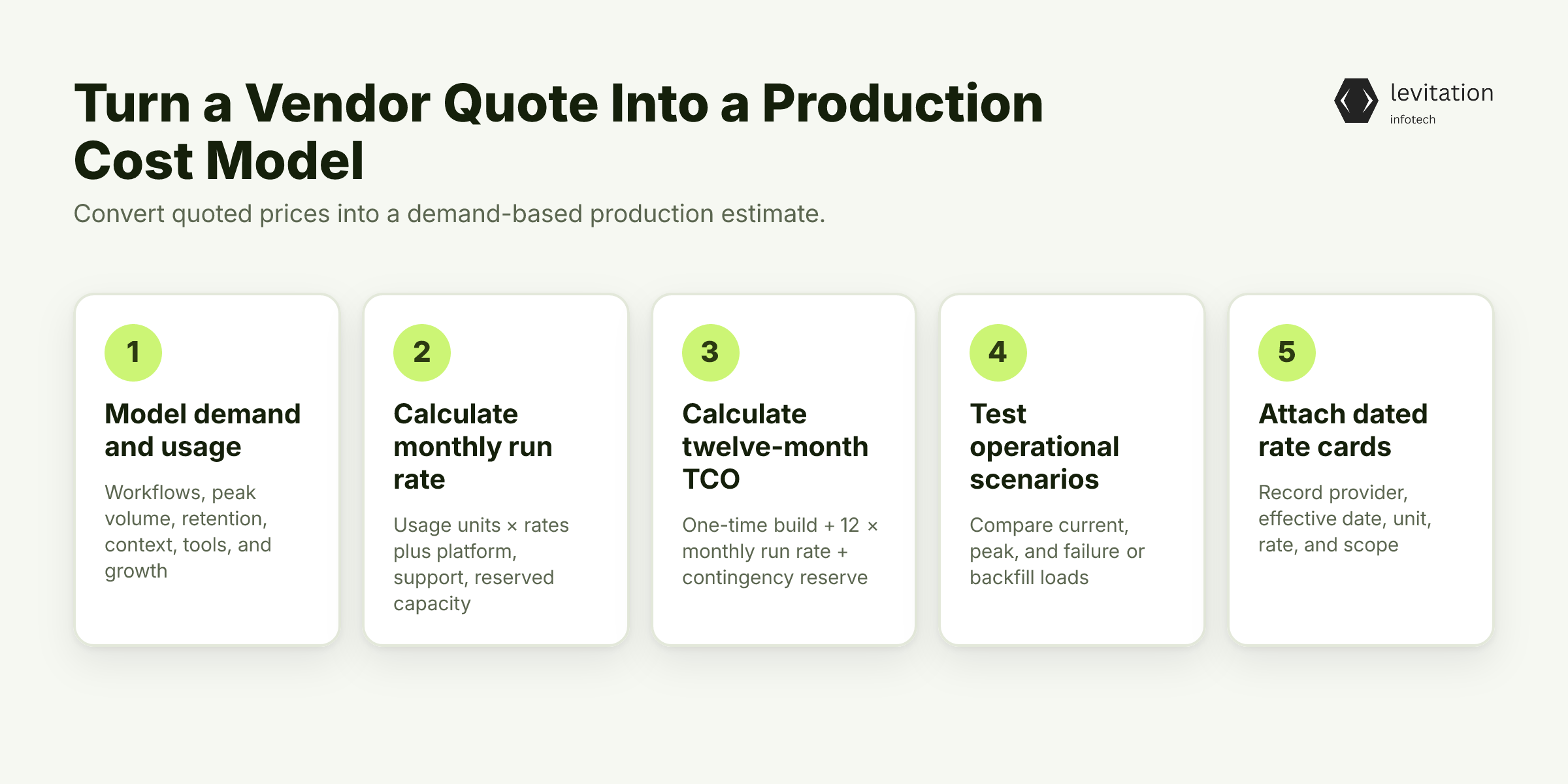
A quote becomes useful only when each line answers four questions: - How much? - At what rate? - Under which assumption? - Who owns it?
Inventory measurable demand
For each source, record the workflows, daily records or events, peak rate, and payload size. Also record the freshness target, retention, and expected growth.
Write down current and peak values. A single average hides bursts. Consider customer support driven by a live case stream, not ticket count alone.
How should context and action volume be recorded?
Model context and actions
Record documents or rows you can search, refresh frequency, and retrieval queries per workflow. Also record average context size, tool calls, downstream actions, and expected human-review rate.
Each item becomes a monthly unit in the next step.
Which items are variable, and which are committed?
Calculate variable and committed spend
Monthly run rate = the sum of each unit × rate, plus platform, support, and reserved-capacity charges.
Committed spend includes base platforms and paid-for capacity. Everything tied to use changes with demand.
How should the investment horizon handle unknowns?
Calculate the investment horizon
12-month TCO = one-time build and integration + 12 × monthly run rate + contingency reserve.
Size the reserve around unresolved assumptions and provider price changes, not habit.
How do normal, peak, and recovery loads change that result?
Model three operational scenarios
The estimator must check three operational scenarios. - Current volume models normal daily demand and the standard refresh cycle. - Expected peak covers the busiest period, campaign, onboarding wave, or seasonal surge. - Failure or backfill tests replayed events, repeated model calls, extra retrieval, and manual cleanup.
Which dated vendor rates should set the estimate?
Attach dated rate cards
Every attached rate card must contain exact pricing and scope details. Record the provider, the date it takes effect, the usage unit, and the rate. List extra-use rules and committed-spend discounts.
State which services sit inside or outside the quoted scope. Detail assumptions that change rates or volumes.
How do you turn those rate cards into an acceptance checklist?
Make it an acceptance checklist
Every recurring line needs a unit, rate, owner, and scenario that changes it.
That rule turns software acceptance into a measurable business check.
Reject fake precision. Label unknown inputs as assumptions and show which test would reduce them.
Do not hide unknowns inside a round rupee figure. The estimator is only as trustworthy as its traffic assumptions. A polite demo hides exactly the cost you fear.
Can the pilot prove those assumptions under live load?
Make the Pilot Expose Production Load
Put the pilot next to the real process, but do not let it write yet.
Use a live shadow path
Connect the pilot in read-only mode to at least one typical production source. Compare its decisions with the existing process before allowing write access.
Read access shows freshness, permissions, and payload changes without creating new business actions.
Can the pilot replay a difficult traffic window?
Replay difficult traffic
Replay a peak-period window with planned faults. The replay test must cover several difficult conditions. - Duplicates and late events - Schema changes - Source outages and permission failures - Retry conditions
Clean traffic only proves that the clean path works.
How can each run reveal what it costs?
Attribute every unit
Tag every run by source, workflow, model, customer or tenant, and successful outcome.
Without outcome tags, costly traffic looks productive. Cost attribution turns a bill into a management signal.
What business outcome should that attribution measure?
Measure business cost
Track cost per completed workflow or successful result, not merely cost per request. Add latency, freshness, errors, rework, and human work beside model spend.
A cheap response still raises total cost when it causes more review or delay.
Which usage controls should stop poor traffic before scale?
Install usage controls early
The pilot must set up several usage controls before scaling. - Role-based access - Selective model tiers - Context limits, caching, and batching - Quotas and alerts - Approved fallback paths
Put these controls in place before volume grows. This keeps the buying process from becoming the constraint.
Agent workloads also need API budgets, not just rate limits.
What conditions must the pilot meet before it graduates?
Define a pilot exit gate
Define strict conditions before the pilot can exit. - A production system design and a cost model with each item listed - An owner for every recurring line - A failure runbook - Agreed quality and freshness thresholds
Do not graduate until every gate is met.
The expanded pilot is not premature production. It is a controlled test of costly assumptions.
The founder can then approve a promise backed by evidence rather than a slide deck.
How should the contract capture that evidence?
Buy an Operating Envelope, Not an AI Demo
A pilot becomes worth funding when it defines an operating envelope. That envelope must handle higher traffic, a failed source, and renewal talks.
Match the contract to the operating model
The proposal must identify the system design, data contracts, cost model, usage controls, and monitoring. It must also name the runbook, support boundary, and owner of third-party spend.
Ask Indian teams offering AI development services to show live-data behavior, failure handling, and cost attribution. A polished interface cannot substitute for those tests.
Which services scale automatically when volume rises?
Define what happens when volume rises
If volume rises, know which services scale automatically and which need paid-for capacity. The terms must state which services have extra-use charges and which need a new business deal.
Which outputs should guide the final decision?
Make the final decision using three outputs
Choose on three outputs, not interface polish. - A bounded production scope - A credible monthly and 12-month cost envelope - Measurable gates for expanding traffic or adding workflows
The payoff is fewer surprise invoices, earlier risk detection, and faster buying. It also offers a clearer path from pilot to operating product.
This follows the principle that Indian GenAI contracts should pay for workflows, not demos.
Which contract terms protect the envelope at renewal?
Frequently Asked Questions
How much does real-time data integration add to AI development cost?
There is no reliable fixed extra cost. The increase depends on source count, event volume, freshness, context size, reliability, and security requirements.
Ask AI development services for separate one-time integration and ongoing data, inference, and operations charges. Price them across low, base, and peak scenarios.
Can a startup build a production AI system for ₹3 lakh?
A ₹3 lakh budget alone cannot establish whether a production AI system is possible. The answer depends on required sources, event volume, freshness, context size, reliability, security, and recurring run rate.
About the author
Mayank Singh is a software developer at Levitation Infotech, where he builds web and AI-powered applications across the company’s fintech, healthcare, and enterprise projects.