


TL;DR: Of 14 enterprise AI inference stacks audited against RBI, HIPAA, and DPDP, only 4 passed. The failure pattern isn't effort or intent. It's that compliance was solved for training but never reworked for real-time serving. Inference is the new audit battleground. Most stacks leak PHI, PII, and audit gaps by default.
Key Takeaways: - Training-time compliance is table stakes. Inference-time compliance is where 10 of 14 stacks failed their audits. - KV caches, embedding stores, and retrieval layers create hidden data surfaces that training-era frameworks never addressed. - The 4 passing stacks built compliance into the serving layer. They used confidential computing, GPU isolation, and audit-grade logs. - A pre-audit program that sequences instrumentation before model serving reaches readiness without the compounding delay of in-house retrofits. - Passing once builds a reusable compliance asset that compresses future audits across adjacent regulatory regimes.
The 4-of-14 Problem Nobody Wants to Talk About
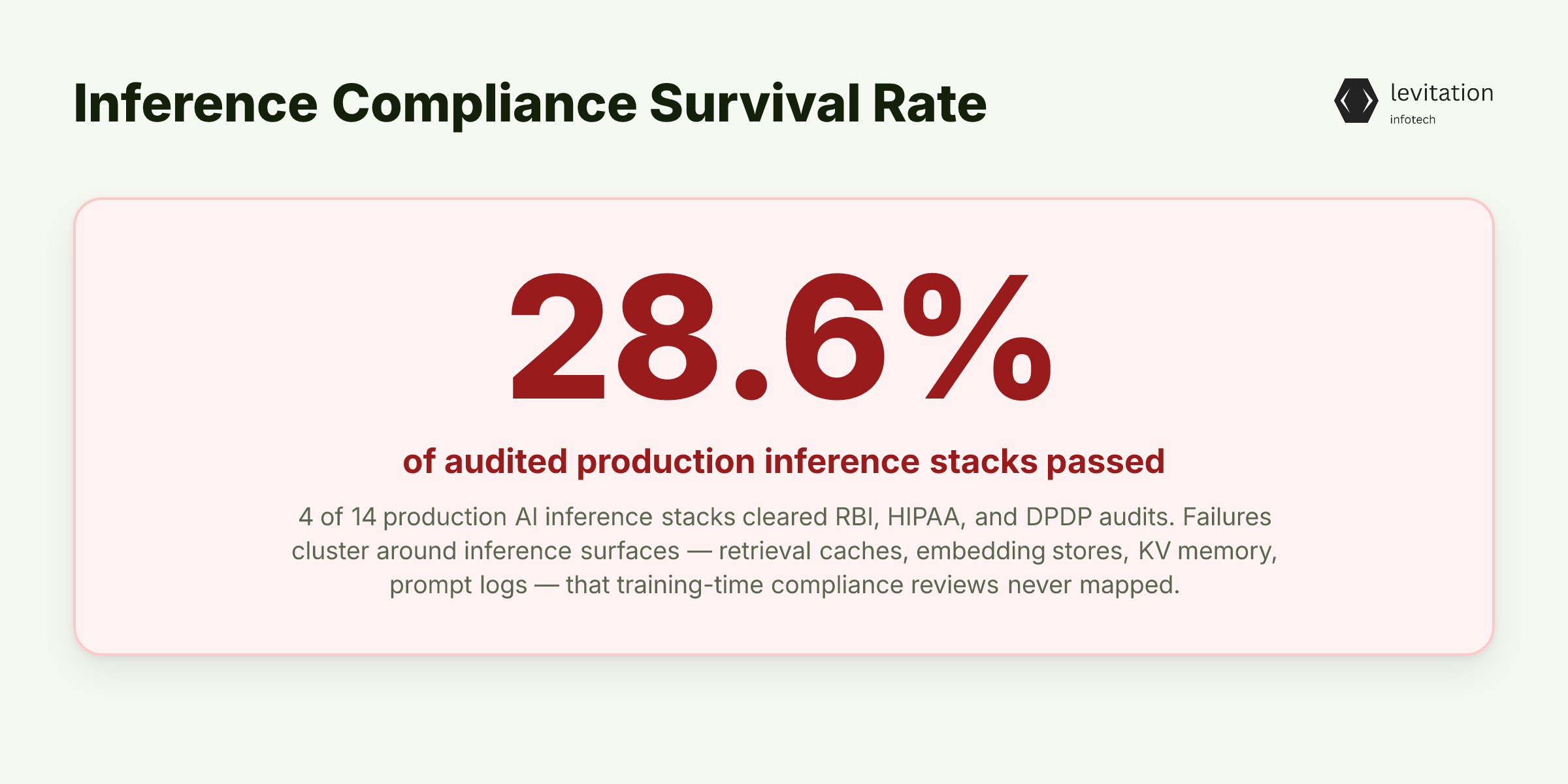
Fourteen inference stacks were put under audit for RBI, HIPAA, and DPDP compliance. Only four passed. That 28.6% survival rate is not a coincidence. It reveals a structural blind spot that most engineering teams discover only when an auditor walks in.
The cohort isn't a collection of amateurs. These were production inference stacks from teams building AI for banks, hospitals, and insurers. They had security teams, legal review, and signed DPAs. They still failed at a 10:4 ratio.
The pattern is more revealing than the number. Failures cluster around inference, not training. Teams that locked down their training data, model weights, and dataset lineage assumed the rest of the system was safe. It wasn't.
Real-time inference moved sensitive data through entirely new surfaces. These include retrieval caches, embedding stores, KV memory, and prompt logs. None of these existed in the compliance map built during AI compliance reviews a year ago.
This is a contrarian thesis. The compliance battlefield has moved. Most engineering organizations still treat AI governance as a training-time problem. The 4-of-14 number says otherwise. Teams that ace dataset governance but ignore inference are the ones failing, including teams whose healthcare LLM stacks were audit-ready on paper but lacked runtime controls at the serving layer.
The gap between training and inference compliance stays invisible until an auditor opens your retrieval layer. They find unencrypted patient context sitting in a vector store. At that point, your training controls don't help you. The same pattern surfaces in clinical AI inference logs, where 9 HIPAA gaps hide by default.
If the failure rate is this high across serious engineering teams, the problem is not effort. It is that the rules of the game have changed. Most teams are still playing the old one. So what changed? Why are auditors now opening the inference layer at all?
Why Audits Now Target Inference, Not Just Training
Inference compliance used to be an afterthought. Train on clean data, document your lineage, sign the BAA, ship the model. That mental model is now a liability.
Every inference call is a data processing event. A patient asks a clinical AI about their medication. A loan officer queries a model for risk scoring. An insurance agent pulls a claims summary. Each request carries live PHI, PII, or financial data through serving infrastructure that most compliance programs never reviewed.
Auditors see this. They also see the resulting ePHI or DPDP-relevant records sitting in your prompt logs, embedding store, and retrieval cache. RBI's FREE-AI committee report has pushed banks past DPDP-style data handling into active AI governance. Explainability is now central, not optional.
Auditors increasingly demand the ability to trace, reconstruct, and justify a specific model output for a specific user. You cannot retrofit that onto a model that was never built for it.
The black-box problem compounds this. When an LLM generates a denial reason for a loan, auditors want to see the prompt. They want the retrieved context, the model version, and the system prompt that shaped the response. Most inference stacks log the final answer and nothing else. That is a guaranteed finding.
Teams that solve AI/ML training compliance but skip inference are discovering this the expensive way. The 14-stack cohort included several teams that had passed SOC 2, ISO 27001, and even prior AI governance reviews. They failed inference-specific audits because their controls stopped at the model boundary.
The fintech AI stacks under RBI governance follow the same curve: strong dataset controls, weak serving-layer controls.
In Levitation's work across regulated industry deployments, the same signal shows up repeatedly. Training compliance gets engineering investment. Inference compliance gets a logging change. That asymmetry is what the 10 failing stacks ran into.
Understanding that inference is the new battleground is necessary but insufficient. The real question is which specific gaps auditors are flagging, and why ten teams missed them.
The 9 Audit Gaps That Sink Clinical AI Inference Logs
Clinical AI inference logs are the highest-risk surface in healthcare AI, and the easiest to get wrong. The 9 HIPAA audit gaps that derail most clinical AI inference stacks aren't exotic edge cases. They are the default behavior of mainstream inference frameworks.
Here is the mechanism. A clinician asks a patient summarization LLM about a case. The system retrieves relevant chart sections, sends them with the prompt to the model, and returns a response. Now audit your pipeline: - The prompt log stores the patient's chart content in plaintext. - The retrieval cache holds the same chunks indexed for the next query. - The embedding store keeps vector representations of the chart. - The KV cache may persist token-level attention state for follow-up turns. - The response log stores the model's output, which often quotes or paraphrases PHI.
Any one of these is an ePHI exposure. Most stacks have all five.
The 9 gaps documented in HIPAA-focused clinical AI audits include: - Missing encryption at rest for prompt and response logs. - Absent access controls on retrieval caches and embedding stores. - No breach notification triggers when inference fails or times out mid-request. - Inadequate minimum-necessary enforcement on context windows. - KV cache and attention state persisting sensitive tokens between sessions. - Untracked model versioning that prevents provenance reconstruction. - Missing audit trails for retrieval queries. - Shared GPU memory that mixes tenant data through time-slicing. - No automated redaction of PHI in logs that flow to downstream analytics.
Notice the pattern. These are infrastructure-level gaps, not model-level gaps. A great model with no explainability hooks still fails. A mediocre model with provenance, isolation, and encryption passes.
The 4 passing stacks from the 14-stack cohort handle each of these gaps as a system property, not a configuration toggle. They instrument the inference layer the same way AI/ML training pipelines instrument data lineage: immutably, queryably, and with the controls mapped to specific regulatory clauses. Teams whose BAA covers the vendor but not the inference layer find this out during remediation, not before.
These gaps are not exotic edge cases. They are the default behavior of most inference frameworks out of the box. So what are the four passing stacks doing differently? And why do confidential AI deployments that look private still fail when auditors read memory dumps?
The Architecture Pattern the Four Passing Stacks Share
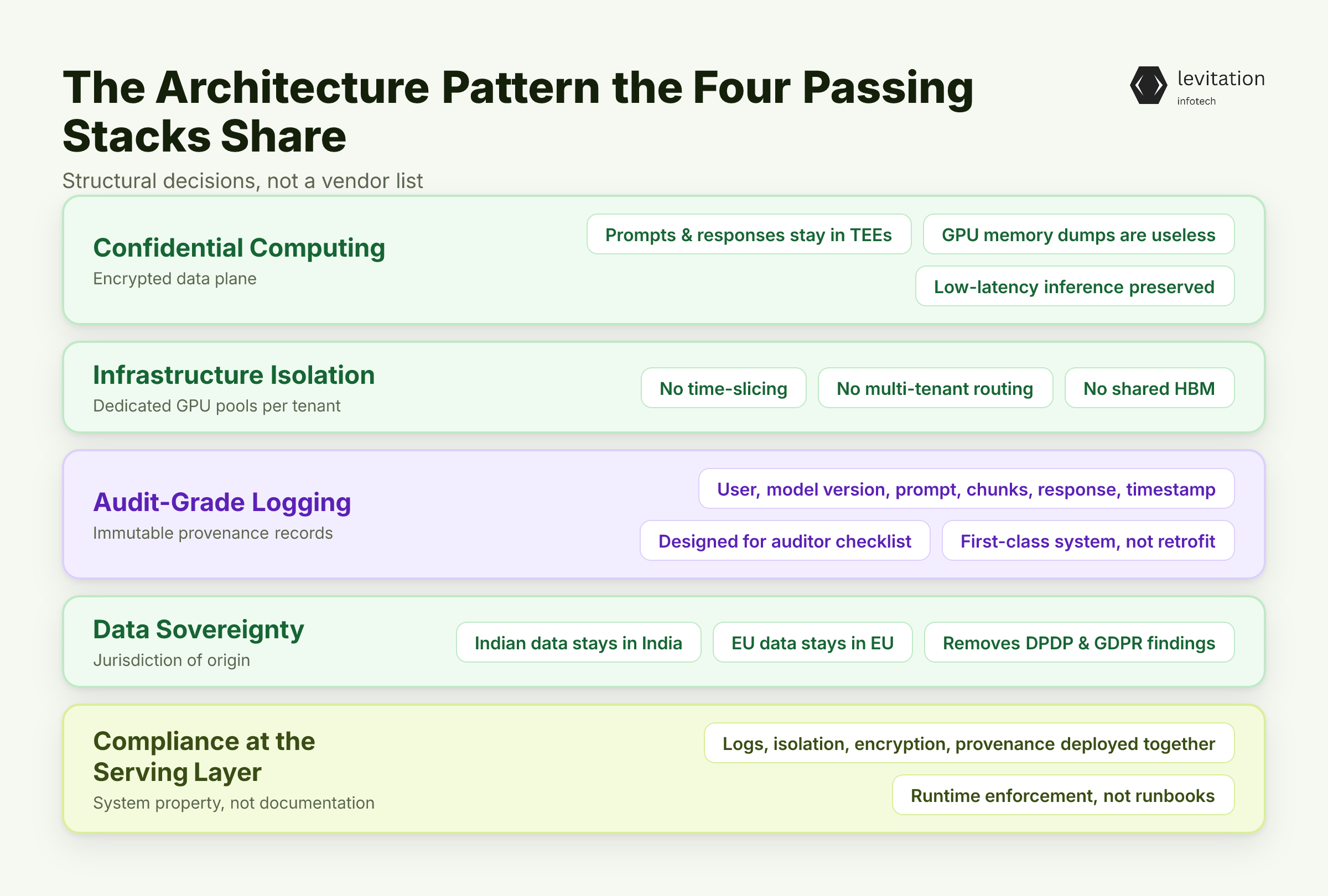
The four stacks that passed share an architecture, not a vendor list. They didn't buy a magic compliance box. They made a set of structural decisions that the other ten teams skipped.
Confidential computing for inference. Prompts, retrieval results, and responses stay inside trusted execution environments. Memory dumps from the GPU become useless to an attacker because the plaintext never exists outside the enclave. The model can still serve low-latency requests, but the data plane is encrypted end to end.
Infrastructure-level isolation. Each tenant or regulated workload gets its own GPU pool. No time-slicing, no multi-tenant routing, no shared HBM. A breach in one pipeline cannot leak into another because they don't share a hardware boundary. This is the opposite of GPU time-slicing that mixes tenant data under the hood for cost savings.
Audit-grade logging as a first-class system. Every inference call produces an immutable record with provenance metadata. The record includes user, model version, system prompt, retrieval chunks used, response, and timestamp. The log schema is designed with the auditor's checklist in mind, not retrofitted after the fact.
Data sovereignty by design. Processing stays within the jurisdiction of origin. Indian patient data does not leave Indian data centers. EU user data stays in EU regions. This single decision removes an entire class of DPDP and GDPR findings.
Compliance built into the serving layer. The pattern is consistent: compliance is a system property, not a documentation exercise. Logs, isolation, encryption, and provenance are deployed, not drafted.
Compare this to the failing pattern. Ten teams treated inference compliance as a wrap-up task. They added a logging library, enabled encryption on the database, and wrote a runbook. None of those produce audit-grade evidence. Documentation does not satisfy a control that requires proven enforcement at runtime.
The gap between confidential compute and HIPAA-safe inference is exactly this. The technology exists, but only when it's wired into the serving layer as a system property does it survive an audit.
Teams following this pattern avoid the compounding delay of retrofitting compliance after deployment. In-house builds without pre-sequencing take longer. Compliance work becomes a tax that compounds with every new model version.
The gap comes from sequencing. The four passing teams instrumented logging, isolation, and encryption as deployable systems. They did this before they wired up the model serving layer. The failing teams did the reverse, and AI compliance work became a retrofit tax that grew with every new model version.
Architecture without execution is just a diagram. Here is the concrete sequencing a CTO can use to pressure-test their own stack before an auditor does it for them.
A 90-Day Pre-Audit Checklist for Engineering Leaders
A pre-audit program works in 90 days if you sequence it correctly. The four passing stacks all followed a roughly similar arc, and so can yours.
Days 1-15: Buy-vs-build screen. Audit whether your existing inference platform can produce the evidence auditors require. Specifically, check for immutable logs with provenance, tenant-isolated GPU pools, encryption at rest for prompt and retrieval caches, and a model registry that maps each output to a versioned artifact.
If your current stack can't answer yes to each, you have a build-versus-buy decision ahead. Most teams that extend their LLM stack cheaply discover auditors disagree with the cost trade-off they made.
Days 16-45: Instrument the inference layer. Every inference call should produce a structured log entry. Map each log field to a specific RBI, HIPAA, or DPDP control. Example for a healthcare workload:
1inference_log:2 request_id: req_abc1233 user_id: dr_smith_0424 patient_id_ref: hashed5 model_version: clinical-llm-v2.46 system_prompt_hash: sha256:9f2c...7 retrieval_chunks: [chunk_ids]8 prompt_text_encrypted: true9 response_text_encrypted: true10 timestamp: 2026-10-11T08:14:22Z11 jurisdiction: in-mumbai-112 data_classification: phi
Days 46-70: Enforce minimum-necessary and scrub state. Restrict context windows to the minimum data required. Scrub KV cache and embedding state between sessions. Disable multi-tenant GPU time-slicing for regulated workloads. Add breach notification triggers on inference failures.
RBI's 2026 AI audit will catch your vendor's mistakes first if your logs don't trace back to a specific model version and jurisdiction.
Days 71-90: Mock audit and fix. Bring in an external reviewer. Run a full audit dry-run. Fix the top three findings before scheduling the real one.
Track a pass-rate metric. What percentage of auditor questions can you answer with system evidence versus documentation?
The four teams that passed treated AI compliance as a deployable system. The ten that failed treated it as a paperwork exercise. That difference shows up in every audit. A checklist helps you pass an audit.
It does not tell you what your organization actually wins when compliance stops being a fire drill. What does that steady state look like for the teams that reach it?
What Changes When Your Inference Stack Passes
The operational payoff of a passing inference stack isn't a certificate. It's what your engineering and sales teams stop having to do.
Sales cycles compress. Procurement and security review stop being the bottleneck. Your compliance package is already audit-proven, so the buyer's CISO and DPO can clear you on the first pass.
Deployment velocity increases. Teams that have already passed one regulatory regime adapt to adjacent ones faster. The same evidence patterns that satisfied HIPAA also satisfy SEBI, IRDAI, and GDPR with minor extensions. You stop rebuilding from scratch every time you enter a new market.
Engineering focus shifts. The audit findings backlog is empty. Your platform team stops firefighting compliance tickets and ships features again. The cognitive load of "is this auditable?" disappears because the answer is always yes.
Teams that ship AI daily but run risk reviews quarterly discover this shift only after they stop having to manually reconcile the two cadences.
The stack becomes a reusable asset. The four passing teams from the 14-stack cohort continue running these systems in production. The infrastructure was designed to be extended rather than rebuilt. Their compliance infrastructure is the foundation for new products, new geographies, and new regulatory regimes.
It compounds, unlike teams whose fintech AI cost forecasts break by month 4 because compliance and capacity planning were never modeled together.
This is what AI/ML training and inference compliance work delivers when done right. A system that gets stronger with every audit cycle, not weaker. Teams that solve this stop treating compliance as a cost center. It becomes a moat. Compliance stops being a project. It becomes a product capability.
Frequently Asked Questions
What is AI inference compliance and why does it differ from training compliance? AI inference compliance covers the regulatory requirements, including data protection, access control, audit logging, and explainability, that apply during model serving. Inference processes live sensitive data in real time, and each request is a data processing event subject to the same rules that govern training pipelines.
If your stack passes inference audits once, the patterns and evidence you build become the foundation for every regulated deployment that follows.
About the author
Mayank Singh is a software developer at Levitation Infotech, where he builds web and AI-powered applications across the company’s fintech, healthcare, and enterprise projects.