


TL;DR: Most Noida AI vendor quotes price the demo, not the production system. The real Year-1 cost combines build cost with ongoing inference, vector database hosting, retraining, and infrastructure spend. A scorecard that separates build cost from run cost is the only way to compare quotes honestly.
Key Takeaways: - A ₹3 lakh build can quietly become a much larger Year-1 investment once inference, retraining, and infrastructure are added - Noida AI quotes vary 6x because vendors define "done" differently, not because their engineering differs - A scorecard that forces vendors to itemize build versus run cost surfaces the real comparison
The ₹3 Lakh Quote Is a Decoy
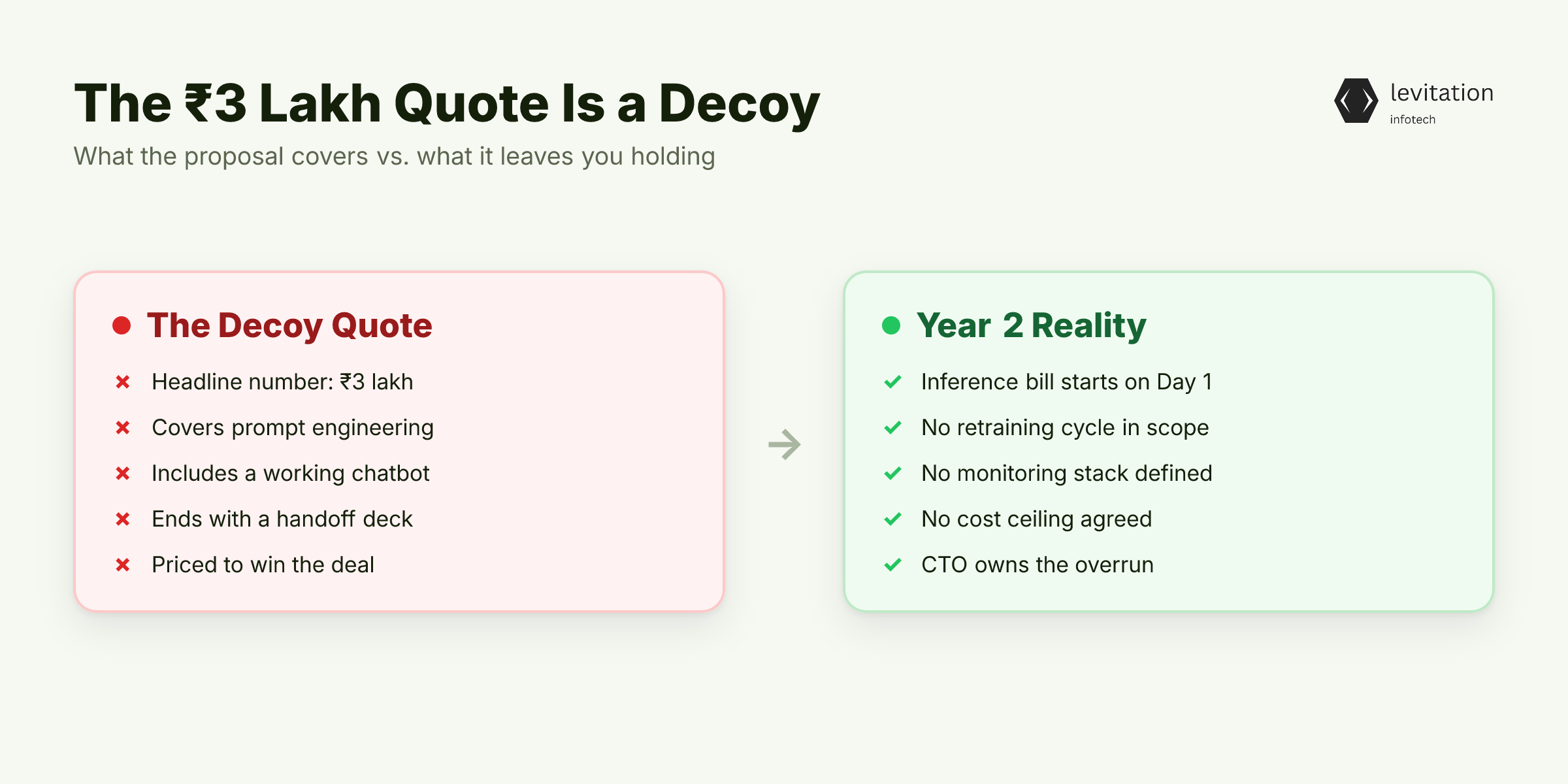
You budgeted ₹3 lakh for the build. By the time real users hit the system, the inference bill is mounting every month, and the vendor's quote never mentioned it. Most Noida AI quotes are written to win the deal, not to survive Year 2.
The math is consistent. AI build costs in India run ₹3 lakh to ₹15 lakh ($3,500 to $18,000) for typical projects, according to 2026 cost calculators.
That range looks reasonable. The problem is what sits beside it.
The decoy is the headline number. The real number is the monthly burn that starts on Day 1 of production. A Noida vendor that quotes ₹3 lakh is pricing the demo, not the system that runs in production.
The proposal covers prompt engineering, a working chatbot, and a handoff deck. It does not cover the inference loop, the retraining cycle, the monitoring stack, or the cost ceiling. When the system goes live and real users hit it, the bill starts to look very different.
CTOs who signed the cheap quote become the people explaining the overrun to the board. The number on the proposal is the smallest number you will ever see on this project. So what does a vendor's "done" definition look like once you pull it apart?
If your first AI quote felt too clean, our Noida AI quotes benchmarked across 19 vendors breaks down the variance in detail. For a deeper look at how Indian quote structures hide scope gaps, see Why Your India AI Quote Won't Match Your Project Cost and Your ₹6 Lakh AI Quote Is Three Items, Not a Project.
What Noida Vendors Don't Put in the Quote
The line items vendors leave out of Noida proposals are remarkably consistent. They look like rounding errors in the proposal. They are the entire operating budget in production.
Here is the standard cost structure most proposals skip: - LLM API spend consumes 40-55% of monthly operating cost for a mid-market chatbot handling 50,000 conversations - Vector database infrastructure quietly takes another 5-15% of the monthly bill - Model drift monitoring, retraining, and evaluation are absent from nearly every proposal reviewed - Internet and base infrastructure add ₹15,000 per month, or ₹1.8 lakh per year - Local GPU electricity adds ₹10,000 per month, or ₹1.2 lakh per year, on top
None of these are edge cases. They are the standard cost structure of any production AI system in India today. The vendor knows the build cost because it ends when the invoice is paid.
The run cost compounds for as long as the system serves users. Most Noida proposals treat the run cost as if it is the buyer's problem, not theirs.
We have seen the same blind spots across three hidden cost categories that triple AI development cost in India. The pattern holds whether you work with a generative ai company or a llm development company. The unit economics are the same.
For a closer look at where inference spend leaks, Stop Bleeding Money on LLM Inference and Why Your Vector DB Is Bleeding Compliance Money map the cost mechanics in detail.
So what does a realistic Year-1 bill actually look like?
The True Year-1 TCO of a Mid-Market AI Chatbot
A realistic Year-1 cost model is layered, not flat. Most Noida proposals flatten it, which is why the total catches boards off guard.
The structure looks like this: - Upfront build: ₹3 lakh to ₹15 lakh for the project - Annual inference: 40-55% of monthly operating cost - Internet and base infrastructure: ₹1.8 lakh per year - Local GPU electricity: ₹1.2 lakh per year - Vector database hosting: 5-15% of the monthly operating bill
The guides that hide this arithmetic are optimizing for lead generation, not buyer education.
API Costs at Production Volume
Inference is the line item that surprises every first-time buyer. Per-query LLM costs compound with traffic, and the bill grows with each month of production volume. Caching, prompt trimming, and routing can cut this, but only if they are designed in from Day 1. Most Noida quotes assume you will figure it out later.
The Retraining Tax
Retraining cycles are left out of nearly every Noida proposal. If your domain knowledge shifts, your model drifts, and the only fix is data refresh plus evaluation plus redeployment. Skipping the retraining line item is the same as signing a maintenance contract with a zero on the end.
For a deeper look at why drift and retraining are line items, not afterthoughts, see Your AI Model Is Drifting and You Don't Know. The variance pattern across Indian vendors is also mapped in Why Fintech AI Costs Vary Three-Fold, and it applies to non-fintech AI too.
If you are evaluating enterprise AI solutions or an ai platform, ask for the run-cost breakdown before you sign. If every Noida quote is missing the same line items, why does the price you get back vary 6x?
Why 19 Noida Quotes Varied 6x Apart
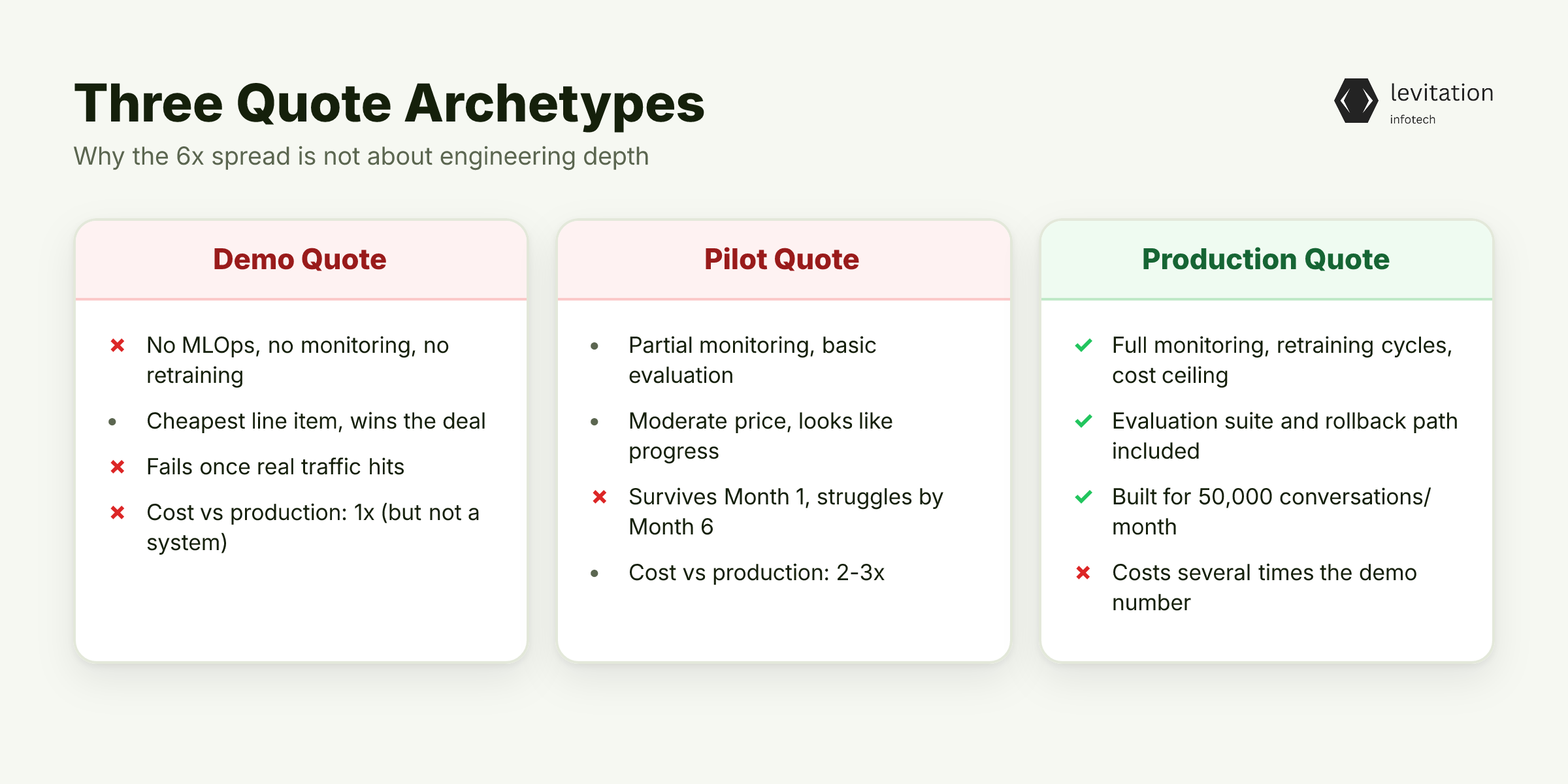
When 19 Noida vendors were asked to quote the same AI chatbot spec, the prices ranged across a 6x spread. The engineering depth did not vary 6x. The definition of "done" did.
A POC quote and a production quote measure different things. A POC that runs for a demo is not a system for 50,000 conversations a month. Production needs monitoring, retraining, and a cost ceiling. The variance comes from what each vendor defines as done.
Three Quote Archetypes
Noida AI proposals fall into three patterns: - The demo quote: cheap, no MLOps, no monitoring, no retraining. Wins the deal. Fails in production. - The pilot quote: moderate price, partial monitoring, basic evaluation. Survives the first month, struggles by Month 6. - The production quote: full monitoring, retraining cycles, cost ceiling, evaluation suite, rollback path. Costs several times the demo number.
The first two are bait. The third is the system you actually need.
The Inclusion Illusion
Many Noida vendors list RAG, fine-tuning, and monitoring as deliverables, then exclude the infrastructure to run them. The proposal reads like production. The line items read like a demo. The buyer discovers the gap in Month 4.
When you compare a scooter to a truck, the scooter always looks like a bargain. For a fuller benchmark of the spread, our Noida AI quotes benchmarked across 19 vendors breaks down the line items. If you are working with an ai development company or scoping custom ai development, ask which archetype you are being quoted. You cannot compare quotes that are not measuring the same thing.
Here is the scorecard that forces apples-to-apples.
A Quote Scorecard Every CTO Should Hand to Vendors
The fastest way to expose hidden cost is to force vendors to answer the same questions in writing. Do not accept a paragraph. Demand a table with a single column for build cost and another for run cost.
The 8 Questions That Expose Hidden Costs - What is the cost per 1,000 queries at our expected production volume? - What is the projected LLM API spend at Month 1, Month 6, and Month 12? - What is the vector database cost at 1M, 10M, and 50M vectors? - What is the retraining frequency, and what does each cycle cost? - What is the monitoring stack, and who owns it after handoff? - How many SLA-bound support hours are included, and what is the overage rate? - What is the documented cost ceiling, and what triggers an alert? - Is the build cost separated from the run cost in a single line-item table?
If a vendor cannot answer these in writing, they are quoting a demo, not a system.
What 'Production-Ready' Must Include
Any quote that claims production-ready must include: - Observability for prompts, retrieval, and outputs - Prompt versioning with rollback - An evaluation suite tied to business metrics - A rollback mechanism for the model and the index - A documented cost ceiling with a paging alert
Reject any quote that does not separate build cost from run cost in a single table. The moment the two are blended, the comparison dies.
For more on the quote patterns Indian vendors use, see 6 Hidden Costs in Noida Software Quotes. We Reviewed 28. and Why Your India AI Quote Won't Match Your Project Cost. When you are evaluating the top ai companies india or an ai agent development company, the scorecard is the only filter that works.
Once the quote is honest, the build-versus-buy decision gets easier, and the timeline numbers do too. So which path actually wins for a mid-market CTO in Noida?
Build, In-House, or Partner: The Honest Trade-Off
The choice between building in-house, hiring a partner, or buying a packaged platform is not really about the build cost. The build cost is roughly the same across all three paths. The divergence lives in your 18-month operating cost and your team's opportunity cost.
When In-House Pays
In-house builds pay off when three conditions are present: - High-volume traffic that makes per-query API cost the dominant line item - Proprietary data that compounds in value with each retraining cycle - A 24-month horizon to recoup annual team cost
If all three hold, in-house wins. If any one is missing, partner math usually beats in-house math.
When a Partner Wins
Partner models win when: - The deployment window is short, not measured in quarters of trial and error - The domain is regulated, like healthcare or BFSI, and audit-ready execution is required - The internal team lacks MLOps depth for drift, retraining, and rollback
Regulated execution requires the same operational discipline across healthcare, BFSI, and any audit-bound vertical. Can your team ship that level of operational discipline in a short window? Or does a partner with a track record get there faster?
For proof of the pattern in healthcare, see HIPAA-Compliant AI Scribes for Indian Hospitals. The replacement rate is mapped in Why 41% of Hospital AI Buys Get Replaced in 18 Months. The replacement rate is the metric that tells you whether in-house depth is realistic or wishful.
Whether you evaluate production AI partners or an ai implementation team, ask one question. Who is accountable at Month 18, and is the run cost predictable?
So what does the math look like when you get it right, and what does it cost when you do not?
What Changes When the TCO Is Honest
When the total cost of ownership is honest, three things change.
First, the monthly burn becomes predictable. CFOs approve budgets that do not move dramatically after launch.
Procurement can compare options without surprise line items. Finance stops being the enemy of the AI roadmap.
Second, partnership quality shows up in retention. You are not orphaned to a handoff deck when the same team that built the system is accountable for running it.
Third, you stop optimizing for the cheapest quote. You start optimizing for the lowest 24-month TCO, which is the only number the board cares about. That shift is what separates a working AI program from a stalled one.
Companies that get this right treat the build quote as one column in a larger table. Not the whole table.
If you are mapping out an ai software development or ai solution development decision this quarter, build the table first. Add a column for the run cost even when the vendor does not.
For the pattern of how a cheap build becomes an expensive run, see How Your ₹2 Lakh AI Chatbot Becomes ₹8 Lakh and Noida's ₹6 Lakh App Is Just the Down Payment. Both walk through the same arithmetic with real line items. The Year-2 cost cliff in healthcare AI is also mapped in Healthcare AI TCO: The Year-Two Cost Cliff.
Teams that ship production AI at scale treat run cost as a deliverable. The enterprise software teams that build for regulated Indian buyers set the bar. That is the posture that makes the math work.
Frequently Asked Questions
What is the typical AI development cost in India in 2026?
For most mid-market projects, AI development cost in India runs ₹3 lakh to ₹15 lakh ($3,500 to $18,000) for the build. Annual operating costs include internet and infrastructure (₹1.8 lakh per year) and local GPU electricity (₹1.2 lakh per year). LLM API spend also takes 40-55% of monthly operating cost. Enterprise generative AI applications with custom RAG and production monitoring land at the higher end of the build range.
How much does AI chatbot development cost for a mid-sized business?
A mid-sized business should budget for both the upfront build and the ongoing run cost. LLM API spend consumes 40-55% of monthly operating cost for a chatbot handling around 50,000 conversations a month. Vector database hosting takes another 5-15% on top.
The total cost depends on traffic volume, retraining cycles, and how much monitoring infrastructure is built in from Day 1.
What are the hidden maintenance costs of generative AI in India?
Generative AI maintenance cost in India includes LLM API spend (40-55% of monthly ops) and vector database hosting (5-15%). Add model drift monitoring, retraining cycles, and change management on top. Internet and infrastructure alone add ₹1.8 lakh per year. Local GPU electricity adds another ₹1.2 lakh per year.
Why do Noida AI vendor quotes vary so widely?
Noida AI quotes vary 6x because vendors define "done" differently. A demo quote excludes MLOps, monitoring, and retraining. A production quote includes all of it.
Without a scorecard forcing vendors to separate build cost from run cost, you are comparing a scooter to a truck.
**Is it cheaper to build AI in-house or outsource to an Indian vendor?
About the author
Mayank Singh is a software developer at Levitation Infotech, where he builds web and AI-powered applications across the company’s fintech, healthcare, and enterprise projects.